"Are we prepared to see them mingling in our Legislatures? Is any portion of this country prepared to see them enter these halls and take their seats by our sides, in perfect equality with the white representatives of an Anglo Saxon race ... to see them placed at the heads of your Departments; or to see, perhaps, some 'Othello' or 'Toussaint' or 'Boyer' gifted with genius and inspired by ambition grasp the presidential wreath, and wield the destinies of this great Republic? From such a picture I turn with irrepressible disgust."The South will never rise again (thank Jesus). And it has instead continued to decline.
Well, it took 172 years, but an African-American with a name a lot more exotic than Othello or Toussaint did indeed become president of these United States. And it was particularly tin-eared, historically speaking, for a member of that self-same South Carolina delegation to hector Barack Obama at last year's State of the Union address. In truth, James Henry Hammond's racist diatribe was milder than those by other Southern "statesmen" who stirred hate and fear among their countrymen in the days leading up to the Civil War.
Jefferson Davis, in a speech to the Confederate Congress in April 1861, extolled slavery as a benevolent invention that allowed a "superior race" to transform "brutal savages into docile, intelligent, and civilized agricultural laborers." Alexander H. Stephens, Jefferson Davis' vice president, proclaimed that Jefferson and the Founders' high-minded declarations of universal liberty were "in violation of the laws of nature." This was profoundly wrong, Stephens said.
"Our new government is founded on exactly the opposite idea," thundered the vice president of the Confederacy. "Its foundations are laid, its cornerstone rests upon the great truth that the Negro is not equal to the white man; that slavery, subordination to the superior race, is his natural and moral condition."
Showing posts with label obama. Show all posts
Showing posts with label obama. Show all posts
Tuesday, March 22, 2011
Barack Obama is Hammond's disgusting picture
Living in South Carolina, this is particularly poignant for me:


Thursday, September 24, 2009
Obama Effect Redux
I played racquetball last night at a city park. Like many city parks located around large black populations, the basketball gym inside was almost entirely filled with young black males playing basketball, having fun, goofing off. What I noticed, and the reason for the title of this post, was a poster over the water fountain that I've never seen before:
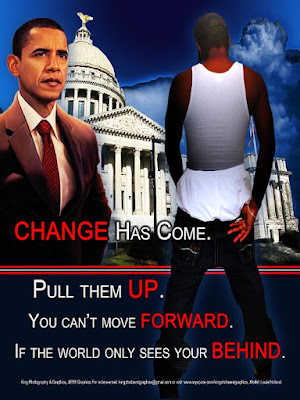
It's apparently the creation of an Atlanta-based designer, King Photography and Graphics. I found it and two other posters like it on www.nomoresagging.com. It dovetails nicely with a question I raised a few months back about Obama's impact on black culture. Although he's personally weighed in against the sort of laws against sagging that Atlanta and other places have considered, he did clearly state that he thought wearing them like that was disrespectful of others.
I don't know how much of an impact things like this have now or will have later, but it is an interesting thing to keep an eye on.

It's apparently the creation of an Atlanta-based designer, King Photography and Graphics. I found it and two other posters like it on www.nomoresagging.com. It dovetails nicely with a question I raised a few months back about Obama's impact on black culture. Although he's personally weighed in against the sort of laws against sagging that Atlanta and other places have considered, he did clearly state that he thought wearing them like that was disrespectful of others.
I don't know how much of an impact things like this have now or will have later, but it is an interesting thing to keep an eye on.
Tuesday, July 21, 2009
The Obama effect
I would never use anecdotal evidence to argue a serious trend. But I do like to use my experiences as a pretext to make horrible generalizations. So let me do that...
The other day at B&N, I noticed a few black families in the children's section with their kids picking out books and reading. This was two days after the president's NAACP speech, which emphasized active parenting, among other things, to solve serious problems in the black community:
Some part of me just thinks that having a black president really has and really will continue to make a serious difference in the cultural attitude of black America. Maybe I'm overly naive.
I also wonder if there's any evidence of this in the serious drop in violent crime rates:
The other day at B&N, I noticed a few black families in the children's section with their kids picking out books and reading. This was two days after the president's NAACP speech, which emphasized active parenting, among other things, to solve serious problems in the black community:
To parents -- to parents, we can't tell our kids to do well in school and then fail to support them when they get home. (Applause.) You can't just contract out parenting. For our kids to excel, we have to accept our responsibility to help them learn. That means putting away the Xbox -- (applause) -- putting our kids to bed at a reasonable hour. (Applause.) It means attending those parent-teacher conferences and reading to our children and helping them with their homework. (Applause.)Perhaps it's just racist of me to assume that there aren't already a lot of black families going to B&N on a Sunday afternoon, but I've been in a lot of bookstores and it definitely made an impression on me as something I don't see often (anecdotal, I know). I guess I'm prone to overestimating the effect that Obama will have on black culture. The fact that so many children are born out-of-wedlock to black women is tied directly to perpetuating the cycle of poverty and crime.
And by the way, it means we need to be there for our neighbor's sons and daughters. (Applause.) We need to go back to the time, back to the day when we parents saw somebody, saw some kid fooling around and -- it wasn't your child, but they'll whup you anyway. (Laughter and applause.) Or at least they'll tell your parents -- the parents will. You know. (Laughter.) That's the meaning of community. That's how we can reclaim the strength and the determination and the hopefulness that helped us come so far; helped us make a way out of no way.
It also means pushing our children to set their sights a little bit higher. They might think they've got a pretty good jump shot or a pretty good flow, but our kids can't all aspire to be LeBron or Lil Wayne. (Applause.) I want them aspiring to be scientists and engineers -- (applause) -- doctors and teachers -- (applause) -- not just ballers and rappers. I want them aspiring to be a Supreme Court Justice. (Applause.) I want them aspiring to be the President of the United States of America. (Applause.)
While 28 percent of white women gave birth out of wedlock in 2007, nearly 72 percent of black women and more than 51 percent of Latinas did.That is just unbelievable. Part of it may be that white women are more likely to be on birth control, part of it may be that white women are more likely to have the financial resources to get an abortion. Adding to this problem comes the higher religiosity of black women, which will guilt them into thinking they shouldn't have an abortion and instead drop out of college.
Some part of me just thinks that having a black president really has and really will continue to make a serious difference in the cultural attitude of black America. Maybe I'm overly naive.
I also wonder if there's any evidence of this in the serious drop in violent crime rates:
The District, New York and Los Angeles are on track for fewer killings this year than in any other year in at least four decades. Boston, San Francisco, Minneapolis and other cities are also seeing notable reductions in homicides.Time will tell, I guess...
"Experts did not see this coming at all," said Andrew Karmen, a criminologist and professor of sociology at the John Jay College of Criminal Justice in New York.
Saturday, June 27, 2009
Healthcare Reform
I will leave hardcore political blogging to those better equipped. But after I read this article by Wendell Potter, a former healthcare insider, who mentioned Remote Area Medical's trip to Wise, VA (also here) as a motivator for abandoning his former job and lobbying for real healthcare reform, I had to link to it. These volunteer doctors, originally intended to do drop-in medicine in the Amazon and Congo, spend 60% of their time doing work inside the USA. Potter worked for CIGNA, who used to be our insurer, and he has two important things to say about healthcare:
- big for-profit insurers have hijacked our health care system and turned it into a giant ATM for Wall Street investors
- the industry is using its massive wealth and influence to determine what is (and is not) included in the health care reform legislation members of Congress are now writing
What I saw happening over the past few years was a steady movement away from the concept of insurance and toward "individual responsibility," a term used a lot by insurers and their ideological allies. This is playing out as a continuous shifting of the financial burden of health care costs away from insurers and employers and onto the backs of individuals. As a result, more and more sick people are not going to the doctor or picking up their prescriptions because of costs. If they are unfortunate enough to become seriously ill or injured, many people enrolled in these plans find themselves on the hook for such high medical bills that they are losing their homes to foreclosure or being forced into bankruptcy.And,
As an industry spokesman, I was expected to put a positive spin on this trend that the industry created and euphemistically refers to as "consumerism" and to promote so-called "consumer-driven" health plans. I ultimately reached the point of feeling like a huckster.
...when I heard members of Congress reciting talking points like the ones I used to write to scare people away from real reform. I'll have more to say about that over the coming weeks and months, but, for now, remember this: whenever you hear a politician or pundit use the term "government-run health care" and warn that the creation of a public health insurance option that would compete with private insurers (or heaven forbid, a single-payer system like the one Canada has) will "lead us down the path to socialism," know that the original source of the sound bite most likely was some flack like I used to be.I really, really hope Obama doesn't cave on the public insurance option. So does Krugman.
Bottom line: I ultimately decided the stakes are too high for me to just sit on the sidelines and let the special interests win again. So I have joined forces with thousands of other Americans who are trying to persuade our lawmakers to listen to us for a change, not just to the insurance and drug company executives who are spending millions to shape reform to benefit them and the Wall Street hedge fund managers they are beholden to.
Saturday, June 13, 2009
Obama and the non-religious
I've been a pretty hopeful supporter of Obama's for some time, despite recognizing his shortcomings in addressing church-state separation (especially in keeping Bush's Office of Faith-based Initiatives) and civil rights (DADT, indefinite detention) to the extent I would like. But he has made historic references to the non-religious and been inclusive in his language, which has made me happy.
This meeting encourages me more:
This meeting encourages me more:
Last week, the Secular Coalition for America, an atheist advocacy group, held its first-ever individual face-to-face with the White House. Ron Millar, the coalition’s acting director, told POLITICO that he met with Paul Montero, Obama’s religious liaison in the White House Office of Public Engagement.Steve Benen's take is accurate:
Obama “is opening a little door to include us in, which we are very appreciative of,” says Millar, who says he anticipates a number of additional such meetings with the administration.
Among the concerns Millar says he touched on was proselytizing in the U.S. military: “That is something we really want to follow up with this administration, because we have not seen much there.”
In April, Joshua DuBois, the Pentecostal minister who now heads Obama’s faith-based office, met with representatives from the Coalition Against Religious Discrimination. Van Pelt, who was among the participants, says that she and others relayed their concerns over the discriminatory hiring practices of faith-based institutions receiving federal funds.
“We have stated what our position is,” Van Pelt says. “But, frankly, we’ve been told that they are listening. They have not been imparting much information to us. So it is kind of a wait-and-see attitude [on our part].”
There have been organizations representing atheists around for decades, but I don't recall ever hearing about one being invited to the White House for a chat. Given that White House officials have also recently engaged plenty of religious groups and communities, from across the theological spectrum -- even a Focus on the Family representative extended generous praise -- it's only fair that they also sit down with an atheist advocacy group.From Obama's Cairo speech:
That said, this seems like an encouraging development concerning the interests of atheists. Historically, administrations would keep a group like the Secular Coalition for America at arm's length. What's more, a meeting like this, not too long ago, may have sparked a controversy.
That this meeting occurred, the group raised legitimate concerns, and no one freaked out about their discussion, looks like a positive development as it relates to diversity of spiritual thought.
There is also one rule that lies at the heart of every religion - that we do unto others as we would have them do unto us. This truth transcends nations and peoples - a belief that isn't new; that isn't black or white or brown; that isn't Christian, or Muslim or Jew. It's a belief that pulsed in the cradle of civilization, and that still beats in the heart of billions. It's a faith in other people, and it's what brought me here today.More of this, please.
Sunday, November 9, 2008
The gods are smiling on me
They must be:
My healthy baby is getting cuter and chubbier every day.
My candidate won the election. Change is coming.

My Gators won the SEC East. They should be ranked #3 today, and will likely be in the BCS Championship Game when they beat Alabama in the SEC Conference Championship. (Certainly so if Texas Tech loses to Oklahoma in two weeks.)
My healthy baby is getting cuter and chubbier every day.
My candidate won the election. Change is coming.
My Gators won the SEC East. They should be ranked #3 today, and will likely be in the BCS Championship Game when they beat Alabama in the SEC Conference Championship. (Certainly so if Texas Tech loses to Oklahoma in two weeks.)
Thursday, November 6, 2008
Appalachia
This morning I saw Krugman's cut on Zell Miller and wanted to find the source of his map (funny how some blogs are horrible about linking to important source material). I found it shortly thereafter at the NYT. (And this interactive one.)
What the map shows is what I feared months ago after the primaries: that the Appalachian region would solidly vote against Obama. Amazingly, only 22% of the counties of the entire USA voted more Republican this election than the last one. Guess where they are heavily concentrated?
 Tazewell County is my home! The poorest, least educated, most religious parts of the country, of course! And it went 2:1 for McCain.
Charles Blow has more depth on the same topic.
What the map shows is what I feared months ago after the primaries: that the Appalachian region would solidly vote against Obama. Amazingly, only 22% of the counties of the entire USA voted more Republican this election than the last one. Guess where they are heavily concentrated?
Tazewell County is my home! The poorest, least educated, most religious parts of the country, of course! And it went 2:1 for McCain.Charles Blow has more depth on the same topic.
Sunday, November 2, 2008
So much for that rumor
When even the WingNutDaily affirmed the authenticity of Obama's birth certificate, other conspiracy-theory-minded nuts should've moved on (or back) to the Muslim Manchurian idea.
Now it's a little difficult to support this one.
Now it's a little difficult to support this one.
State declares Obama birth certificate genuineAnother smear bites the dust.
1 day ago
HONOLULU (AP) — State officials say there's no doubt Barack Obama was born in Hawaii.
Health Department Director Dr. Chiyome Fukino said Friday she and the registrar of vital statistics, Alvin Onaka, have personally verified that the health department holds Obama's original birth certificate.
Fukino says that no state official, including Republican Gov. Linda Lingle, ever instructed that Obama's certificate be handled differently.
She says state law bars release of a certified birth certificate to anyone who does not have a tangible interest.
Some Obama critics claim he was not born in the US.
Earlier Friday, a southwest Ohio magistrate rejected a challenge to Obama's citizenship. Judges in Seattle and Philadelphia recently dismissed similar suits.
Thursday, October 30, 2008
Barack TV
I watched Barack's 30 minute ad and thought it was very well-done. This guy will win, and whether he does or not, he's forever changed the art and science of campaigning.
Godless money
Dole is losing to Kay Hagan in NC, and thus is using fear of us mean evil atheists to scare people away from her opponent. I just didn't know that there was such a thing as "godless money" lol.
Seed Magazine endorsed Obama. No surprise there.
A new article in Newsweek discusses belief in the paranormal and supernatural as a coping mechanism.
Hitchens debated the guy who wrote, "I Don't Have Enough Faith to be an Atheist".
Seed Magazine endorsed Obama. No surprise there.
A new article in Newsweek discusses belief in the paranormal and supernatural as a coping mechanism.
Hitchens debated the guy who wrote, "I Don't Have Enough Faith to be an Atheist".
Saturday, October 11, 2008
It's getting difficult to guard the optimism
As I said on Tue, the polls for Obama look great and if this holds, he should win in 23 days. As of this morning, fivethirtyeight.com shows him with a 91% win probability, a 5-point popular vote spread (51.9:46.6)and 348 EV (270 needed), Pollster gives him 320 EV and an 8-point popular vote spread (49.8:41.9), while Intrade has him with 80% probability to win.
One of the neat things you can do is go to 270towin and play with the states to see various outcomes for the election. Taking for granted a win in all the 2004 Kerry states, it appears that Obama has also solidly locked in Iowa and New Mexico, bringing him to 264 EV. Amazingly, all Obama has to do is win one of the remaining tossup states: FL, OH, VA, NC, IN, CO, NV, or MO. McCain has to sweep every one of these swing states to win...and that's why sites that run probabilities like fivethirtyeight have Obama winning with 9:1 odds given current polling data.
Basically, my predicted map is shown below, in which Obama wins OH but loses FL, wins VA but loses NC, wins CO but loses NV, wins 1 of the 5 NE districts (Omaha) but loses both MO and IN. This would give Obama 307 EV to McCain's 231. I also predict Obama to win around 51% of the popular vote and I think McCain will get around 48.5%, with third-party candidates drawing less than expected due to the financial crisis:
 Aren't prognostications fun?
And here's a countdown clock for the election:
One of the neat things you can do is go to 270towin and play with the states to see various outcomes for the election. Taking for granted a win in all the 2004 Kerry states, it appears that Obama has also solidly locked in Iowa and New Mexico, bringing him to 264 EV. Amazingly, all Obama has to do is win one of the remaining tossup states: FL, OH, VA, NC, IN, CO, NV, or MO. McCain has to sweep every one of these swing states to win...and that's why sites that run probabilities like fivethirtyeight have Obama winning with 9:1 odds given current polling data.
Basically, my predicted map is shown below, in which Obama wins OH but loses FL, wins VA but loses NC, wins CO but loses NV, wins 1 of the 5 NE districts (Omaha) but loses both MO and IN. This would give Obama 307 EV to McCain's 231. I also predict Obama to win around 51% of the popular vote and I think McCain will get around 48.5%, with third-party candidates drawing less than expected due to the financial crisis:
 Aren't prognostications fun?
And here's a countdown clock for the election:
Golden line
From Gail Collins' column in today's NYT (links added by me):
PS: Economists who once backed McCain's economic plans are now balking at his proposal to buy mortgages directly from banks.
PSS: Someone should lose a hand (or at least a finger) over this.
Palin has been pressing the line that people don’t really know “the real Barack Obama,” and who could make the argument better than a woman who we’ve already known for almost six weeks? Really, she’s like one of the family.*drum sting*
We’ve gotten so close we’ve already learned that she didn’t actually sell the plane on eBay, didn’t actually visit the troops in Iraq and didn’t really have a talk with the British ambassador. As soon as we get the Trooper thing and Alaska Independence Party thing and the tax thing figured out, she’ll be an open book.
PS: Economists who once backed McCain's economic plans are now balking at his proposal to buy mortgages directly from banks.
PSS: Someone should lose a hand (or at least a finger) over this.
Friday, October 10, 2008
Politics notes
Alaska's bipartisan investigation ends with the conclusion that "Gov. Sarah Palin abused her power by violating Alaska Statute 39.52.110(a) of the Alaska Executive Branch Ethics Act." Read it for yourself. It's obvious that she got in trouble for lying about it more than anything else. And the stonewalling didn't help either.
The whole ACORN thing deconstructed.
After seeing his inflammatory rhetoric result in lots of blowback, Sen. McCain tried to walk back the harsh attacks on Obama's character today at a rally. He was booed. He called for "respect"...simultaneously, and with no hint of irony, McCain is running the "blind ambition" ad accusing Obama of "lying" about Ayers. Not that they'll bother to document this "lie" since it would expose their own.
Meanwhile, Cindy broke the irony meter when accusing Obama of running "the dirtiest campaign ever..."
Maybe Obama should release a video smearing Palin? Never mind.
Nobel Prize-winning economist Joe Stiglitz explains the causes of the current financial crisis:
The whole ACORN thing deconstructed.
After seeing his inflammatory rhetoric result in lots of blowback, Sen. McCain tried to walk back the harsh attacks on Obama's character today at a rally. He was booed. He called for "respect"...simultaneously, and with no hint of irony, McCain is running the "blind ambition" ad accusing Obama of "lying" about Ayers. Not that they'll bother to document this "lie" since it would expose their own.
Meanwhile, Cindy broke the irony meter when accusing Obama of running "the dirtiest campaign ever..."
Maybe Obama should release a video smearing Palin? Never mind.
Nobel Prize-winning economist Joe Stiglitz explains the causes of the current financial crisis:
The new populist rhetoric of the right—persuading taxpayers that ordinary people always know how to spend money better than the government does, and promising a new world without budget constraints, where every tax cut generates more revenue—hasn’t helped matters. Special interests took advantage of this seductive mixture of populism and free-market ideology. They also bent the rules to suit themselves. Corporations and the wealthy argued that lowering their tax rates would lead to more savings; they got the tax breaks, but America’s household savings rate not only didn’t rise, it dropped to levels not seen in 75 years. The Bush administration extolled the power of the free market, but it was more than willing to provide generous subsidies to farmers and erect tariffs to protect steelmakers. Lately, as we have seen, it seems willing to write blank checks to bail out its friends on Wall Street. In each of these cases there are clear winners. And in each there are clear losers—including the country as a whole.BTW, Stiglitz is the most-cited economist in the world.
...
The federal government needs to give a hand to states and localities—their tax revenues are plummeting, and without help they will face costly cutbacks in investment and in basic human services. The poor will suffer today, and growth will suffer tomorrow. The big advantage of a program to make up for the shortfall in the revenues of states and localities is that it would provide money in the amounts needed: if the economy recovers quickly, the shortfall will be small; if the downturn is long, as I fear will be the case, the shortfall will be large.
These measures are the opposite of what the administration—along with the Republican presidential nominee, John McCain—has been urging. It has always believed that tax cuts, especially for the rich, are the solution to the economy’s ills. In fact, the tax cuts in 2001 and 2003 set the stage for the current crisis. They did virtually nothing to stimulate the economy, and they left the burden of keeping the economy on life support to monetary policy alone. America’s problem today is not that households consume too little; on the contrary, with a savings rate barely above zero, it is clear we consume too much. But the administration hopes to encourage our spendthrift ways.
What has happened to the American economy was avoidable. It was not just that those who were entrusted to maintain the economy’s safety and soundness failed to do their job. There were also many who benefited handsomely by ensuring that what needed to be done did not get done. Now we face a choice: whether to let our response to the nation’s woes be shaped by those who got us here, or to seize the opportunity for fundamental reforms, striking a new balance between the market and government.
Wednesday, October 8, 2008
Politics notes
Following up an earlier item about the growing gulf between the GOP's policies and science's reality, the 63rd Nobel Prize winner has now endorsed Obama. The text of the letter which the signatories affirm:
Following up an earlier item on blaming the poor and minorities for the current financial crisis, Newsweek tackles the argument head-on:
This year's presidential election is among the most significant in our nation's history. The country urgently needs a visionary leader who can ensure the future of our traditional strengths in science and technology and who can harness those strengths to address many of our greatest problems: energy, disease, climate change, security, and economic competitiveness.Do remember that my question to CNN involved retaining the USA's status as a scientific superpower.
We are convinced that Senator Barack Obama is such a leader, and we urge you to join us in supporting him.
During the administration of George W. Bush, vital parts of our country's scientific enterprise have been damaged by stagnant or declining federal support. The government's scientific advisory process has been distorted by political considerations. As a result, our once dominant position in the scientific world has been shaken and our prosperity has been placed at risk. We have lost time critical for the development of new ways to provide energy, treat disease, reverse climate change, strengthen our security, and improve our economy.
We have watched Senator Obama's approach to these issues with admiration. We especially applaud his emphasis during the campaign on the power of science and technology to enhance our nation's competitiveness. In particular, we support the measures he plans to take – through new initiatives in education and training, expanded research funding, an unbiased process for obtaining scientific advice, and an appropriate balance of basic and applied research – to meet the nation's and the world's most urgent needs.
Senator Obama understands that Presidential leadership and federal investments in science and technology are crucial elements in successful governance of the world's leading country. We hope you will join us as we work together to ensure his election in November.
Following up an earlier item on blaming the poor and minorities for the current financial crisis, Newsweek tackles the argument head-on:
Indeed.The Community Reinvestment Actapplies to depository banks. But many of the institutions that spurred the massive growth of the subprime market weren't regulated banks. They were outfits such as Argent and American Home Mortgage, which were generally not regulated by the Federal Reserve or other entities that monitored compliance with CRA. These institutions worked hand in glove with Bear Stearns and Lehman Brothers, entities to which the CRA likewise didn't apply. There's much more. As Barry Ritholtz notes in this fine rant, the CRA didn't force mortgage companies to offer loans for no-money down, or to throw underwriting standards out the window, or to encourage mortgage brokers to aggressively seek out new markets. Nor did the CRA force the credit-rating agencies to slap high-grade ratings on subprime debt.
Second, many of the biggest flameouts in real estate have had nothing to do with subprime lending. WCI Communities, builder of highly amenitized condos in Florida (no subprime purchasers welcome there), filed for bankruptcy in August. Very few of the tens of thousands of now-surplus condominiums in Miami were conceived to be marketed to subprime borrowers, or minorities—unless you count rich Venezuelans and Colombians as minorities. The multi-year plague that has been documented in brilliant detail at IrvineHousingBlog is playing out in one of the least subprime housing markets in the nation.
Third, lending money to poor people and minorities isn't inherently risky. There's plenty of evidence that in fact it's not that risky at all. That's what we've learned from several decades of microlending programs, at home and abroad, with their very high repayment rates. And as The New York Times recently reported, Nehemiah Homes, a long-running initiative to build homes and sell them to the working poor in subprime areas of New York's outer boroughs, has a repayment rate that lenders in Greenwich, Conn., would envy. In 27 years, there have been fewer than 10 defaults on the project's 3,900 homes. That's a rate of 0.25 percent.
On the other hand, lending money recklessly to obscenely rich white guys, such as Richard Fuld of Lehman Brothers, or Jimmy Cayne of Bear Stearns, can be really risky. In fact, it's even more risky, since they have a lot more borrowing capacity. And, here, again, it's difficult to imagine how Jimmy Carter could be responsible for the supremely poor decision-making seen in the financial system. I await the Krauthammer column in which he points out the specific provision of the Community Reinvestment Act that forced Bear Stearns to run with an absurd leverage ratio of 33:1, that instructed Bear Stearns hedge-fund managers to blow up hundreds of millions of their clients money, and that required its septuagenarian CEO to play bridge while his company ran into trouble. Perhaps Neil Cavuto knows which CRA clause required Lehman Brothers to borrow hundreds of billions of dollars in short-term debt in the capital markets and then buy tens of billions of dollars of commercial real estate at the top of the market. I can't find it. Did AIG plunge into the credit-default swaps business with abandon because ACORN members picketed its offices? Please. How about the hundreds of billions of dollars of leveraged loans—loans banks committed to private equity firms that wanted to conduct leveraged buyouts of retailers, restaurant companies, and industrial firms? Many of those are going bad now, too. Is that Bill Clinton's fault?
Tuesday, October 7, 2008
Polls show a very good chance to win for Obama
Things are looking good in Obamaland. He's predicted to win with good odds. Of course that means McCain will grow more and more desperate with each passing day trying to sling mud and hope that some of it sticks. One wonders if McCain's "honor" of which he's written often (and his ghost writer Mark Salter) over the years will give him any sense of shame down the road.
fivethirtyeight.com's current analysis has him at 345 and pollster.com has him at 320.
As a supporter who has seen a lot since January 2007, it is amazing and I never knew if we'd ever get here. Like many Dems, there's a nervous gnawing sense that something will go wrong. But I just think, despite the best efforts of Faux Noise and the right wing, Obama will win absent a cataclysmic new revelation or gaffe during a debate. The problem for McCain is that the voters are, by now, almost all cemented in their choices with very few undecideds left and very few "swayable" decideds.
I'm showing two maps below:
fivethirtyeight's map:

And Pollster's map, which currently (10/7) gives Obama 320 with 55 tossup:
...my fingers remain crossed...
fivethirtyeight.com's current analysis has him at 345 and pollster.com has him at 320.
As a supporter who has seen a lot since January 2007, it is amazing and I never knew if we'd ever get here. Like many Dems, there's a nervous gnawing sense that something will go wrong. But I just think, despite the best efforts of Faux Noise and the right wing, Obama will win absent a cataclysmic new revelation or gaffe during a debate. The problem for McCain is that the voters are, by now, almost all cemented in their choices with very few undecideds left and very few "swayable" decideds.
I'm showing two maps below:
fivethirtyeight's map:
And Pollster's map, which currently (10/7) gives Obama 320 with 55 tossup:
...my fingers remain crossed...
Sunday, October 5, 2008
McCain's shady associations and bad judgment
**UPDATE: I just got an email from David Plouffe sent to Obama supporters that directs to this website, where a 13-min documentary on McCain's role in the Keating 5 scandal and its parallels to today's financial crisis will be up today by noon. You can see the preview now. Ouch.**
So it seems that the McCain campaign will be slinging as much mud as possible in its last desperate attempt to win. They're now dialing up the volume on Obama's "character and judgment" based on his past associations.
Okay, let's play.
Palin is talking about Ayers. If talking about William Ayers, a man Obama barely knows and met as a fellow Professor at the University of Chicago, is germane then surely talking about Charles Keating is. The fact that McCain was formally investigated by the Senate Ethics Committee, while Obama has never been formally investigated by any panel, despite all the media digging, is telling. It's also telling that McCain's running mate is under ethics investigations, (despite all the stonewalling) as well.
If talking about how Rezko helped Obama by buying a part of his parcel then later re-selling it to him at fair market value is germane, then surely talking about how McCain's first failed marriage, followed by his mistress-turned-wife Cindy and her father launched McCain's campaign with their own money, then invested $350K into a Keating shopping mall in April 1986 is.
And it isn't like McCain's ability to be bought off by corporations ended 20 years ago. Far from it. In 1998 and 1999, McCain worked hard on behalf of a corporation with a hot lobbyist, writing letters to the FCC to push for deregulation to make those companies more money. Vicki Iseman (very sexy lady) schmoozed McCain for years, herself working as a lobbyist for Paxson and Glencairn, telecom companies who benefitted from McCain's influence to deregulate the telecom industry. Rumors abounded that McCain was fu&*ing the broad, but whether or not that's true, he definitely did her clients favors.
I just don't know if the McCain campaign wants to go down this road. If they do, then it's past time to counter-punch. Given the relevance of the McCain's ties to the S&L banking scandal of the 1980's and his ties to today's financial crisis through Phil Gramm and deregulation, I say, as King George famously said, "Bring 'em on."
So it seems that the McCain campaign will be slinging as much mud as possible in its last desperate attempt to win. They're now dialing up the volume on Obama's "character and judgment" based on his past associations.
Okay, let's play.
Palin is talking about Ayers. If talking about William Ayers, a man Obama barely knows and met as a fellow Professor at the University of Chicago, is germane then surely talking about Charles Keating is. The fact that McCain was formally investigated by the Senate Ethics Committee, while Obama has never been formally investigated by any panel, despite all the media digging, is telling. It's also telling that McCain's running mate is under ethics investigations, (despite all the stonewalling) as well.
If talking about how Rezko helped Obama by buying a part of his parcel then later re-selling it to him at fair market value is germane, then surely talking about how McCain's first failed marriage, followed by his mistress-turned-wife Cindy and her father launched McCain's campaign with their own money, then invested $350K into a Keating shopping mall in April 1986 is.
And it isn't like McCain's ability to be bought off by corporations ended 20 years ago. Far from it. In 1998 and 1999, McCain worked hard on behalf of a corporation with a hot lobbyist, writing letters to the FCC to push for deregulation to make those companies more money. Vicki Iseman (very sexy lady) schmoozed McCain for years, herself working as a lobbyist for Paxson and Glencairn, telecom companies who benefitted from McCain's influence to deregulate the telecom industry. Rumors abounded that McCain was fu&*ing the broad, but whether or not that's true, he definitely did her clients favors.

I just don't know if the McCain campaign wants to go down this road. If they do, then it's past time to counter-punch. Given the relevance of the McCain's ties to the S&L banking scandal of the 1980's and his ties to today's financial crisis through Phil Gramm and deregulation, I say, as King George famously said, "Bring 'em on."
Saturday, October 4, 2008
Economists favor Obama by huge margins
Academic economists overwhelmingly favor Obama to win:
The detailed responses are bad news for Mr McCain (the full data are available here). Eighty per cent of respondents and no fewer than 71% of those who do not cleave to either main party say Mr Obama has a better grasp of economics. Even among Republicans Mr Obama has the edge: 46% versus 23% say Mr Obama has the better grasp of the subject.A nice thing to mention on the campaign trail. Plus the fact that McCain is advised by a bunch of financial lobbyists, while Obama is endorsed by economists 2:1 over McCain.
...
A candidate’s economic expertise may matter rather less if he surrounds himself with clever advisers. Unfortunately for Mr McCain, 81% of all respondents reckon Mr Obama is more likely to do that; among unaffiliated respondents, 71% say so.
...
On our one-to-five scale, economists on average give Mr Obama’s economic programme a 3.3 and Mr McCain’s a 2.2. Mr Obama, says Jonathan Parker, a non-aligned professor at Northwestern’s Kellogg School of Management, “is a pragmatist not an ideologue. I expect Clintonian economic policies.” If, that is, crushing federal debt does not derail his taxing and spending plans.
On his plans to fix the financial crisis, Mr Obama averages 3.1, a point higher than Mr McCain. Still, some said they didn’t quite know what they were rating—reasonably enough, since neither candidate has produced clear plans of his own.
Where the candidates’ positions are more clearly articulated, Mr Obama scores better on nearly every issue: promoting fiscal discipline, energy policy, reducing the number of people without health insurance, controlling health-care costs, reforming financial regulation and boosting long-run economic growth. Twice as many economists think Mr McCain’s plan would be bad or very bad for long-run growth as Mr Obama’s. Given how much focus Mr McCain has put on his plan’s benefits for growth, this last is quite a repudiation.
Mr McCain gets his highest mark, an average of 3.5 and a clear advantage over Mr Obama, for his position on free trade and globalisation. If Mr Obama “would wake up on free trade”, one respondent says, “I could get behind the plans much more.” Perhaps surprisingly, the economists rated trade low in priority compared with the other issues listed. Only 53% say it is important or very important. Neither candidate scored at all well on dealing with the burgeoning cost of entitlements such as Medicare and Social Security.
The economists also prefer Mr Obama’s tax plans. Republicans and respondents who do not identify with either political party see Mr McCain’s tax policies as more efficient but less equitable. But the former prefer Mr McCain’s plans—43% of Republicans say they are good or very good—and the latter Mr Obama’s. Of non-affiliated respondents, 31% say Mr Obama’s are good or very good.
Either way, according to the economists, it would be difficult to do much worse than George Bush. The respondents give Mr Bush a dismal average of 1.7 on our five-point scale for his economic management. Eighty-two per cent thought Mr Bush’s record was bad or very bad; only 1% thought it was very good.
The Democrats were overwhelmingly negative, but nearly every respondent viewed Mr Bush’s record unfavourably. Half of Republican respondents thought Mr Bush deserves only a 2. “The minimum rating of one severely overestimates the quality of Bush’s economic policies,” says one non-aligned economist.
Friday, September 26, 2008
Setting expectations
I'm going in the opposite direction of the Obama campaign: setting the bar high for McCain bothers me. After blinking in a game of chicken, tonight is supposed to be McCain's "home field advantage" as everyone in the media tells me that McCain's "strength" is his foreign policy expertise. Well, I find that troubling...for many reasons:
McCain has made some serious errors in judgment in foreign policy, as well as some relatively minor confusions on the facts. Why then should he get the label "expert" in foreign policy?
This is, after all, the guy who confused the basic facts about the "Surge Policy" that he has claimed so much credit for.
The guy who won't meet with our ally - Spain?
The guy who is confused about his own position on the Iraq War, and whether or not he opposed it, and when, and whether or not he thought it would be "an easy victory"?
The guy who was confused about the need to go into Iraq way back in Jan 2002?
There's more:
McCain has made some serious errors in judgment in foreign policy, as well as some relatively minor confusions on the facts. Why then should he get the label "expert" in foreign policy?
This is, after all, the guy who confused the basic facts about the "Surge Policy" that he has claimed so much credit for.
The guy who won't meet with our ally - Spain?
The guy who is confused about his own position on the Iraq War, and whether or not he opposed it, and when, and whether or not he thought it would be "an easy victory"?
The guy who was confused about the need to go into Iraq way back in Jan 2002?
There's more:
Let's also not lose sight of the broader pattern. McCain thinks the recent conflict between Russia and Georgia was "the first probably serious crisis internationally since the end of the Cold War." He thinks Iraq and Pakistan share a border. He believes Czechoslovakia is still a country. He's been confused about the difference between Sudan and Somalia. He's been confused about whether he wants more U.S. troops in Afghanistan, more NATO troops in Afghanistan, or both. He's been confused about how many U.S. troops are in Iraq. He's been confused about whether the U.S. can maintain a long-term presence in Iraq. He's been confused about Iran's relationship with al Qaeda. He's been confused about the difference between Sunni and Shi'ia. McCain, following a recent trip to Germany, even referred to "President Putin of Germany." All of this incoherence on his signature issue.Indeed.
Wednesday, September 17, 2008
Rothkopf and Krugman on regulating financials
In response to the laissez-faire-style GOP economics of the past two decades or so, I offer this:
In this post from March 21, he explains what is happening:
In this post from March 24, Krugman makes the essential argument that must be made to prevent the toxic mixture of "hand-off" government and greedy banks from happening again:
In this post, he argues that the Administration's response is not real regulation and change, but re-shuffling deck chairs on the Titanic:
“We are at the end of an era — the end of ‘leave it to the markets’ and of the great cop-out that less government is always better government,” argues David Rothkopf, a former Commerce Department official in the Clinton administration and author of a book about the world’s financial leaders who brought about this crisis: “Superclass: The Global Power Elite and the World They Are Making.” “I think, however, it is important to stress the difference between smart government and simply more government.As always, Paul Krugman (MIT-trained Princeton prof. of economics) is the go-to guy for concise explanations on how and why the financial crisis happened and what to do about it.
“We do not need a regulatory ‘surge’ on Wall Street,” he added. “We need a complete rethinking of how we make global financial markets more transparent and how we ensure that the risks within those markets — .many of which are new and many of which are not well understood even by the experts — are managed and monitored properly.”
In this post from March 21, he explains what is happening:
Contrary to popular belief, the stock market crash of 1929 wasn’t the defining moment of the Great Depression. What turned an ordinary recession into a civilization-threatening slump was the wave of bank runs that swept across America in 1930 and 1931.So now the question is -- what lessons do we learn and what do we change?
This banking crisis of the 1930s showed that unregulated, unsupervised financial markets can all too easily suffer catastrophic failure.
As the decades passed, however, that lesson was forgotten — and now we’re relearning it, the hard way.
To grasp the problem, you need to understand what banks do.
Banks exist because they help reconcile the conflicting desires of savers and borrowers. Savers want freedom — access to their money on short notice. Borrowers want commitment: they don’t want to risk facing sudden demands for repayment.
Normally, banks satisfy both desires: depositors have access to their funds whenever they want, yet most of the money placed in a bank’s care is used to make long-term loans. The reason this works is that withdrawals are usually more or less matched by new deposits, so that a bank only needs a modest cash reserve to make good on its promises.
But sometimes — often based on nothing more than a rumor — banks face runs, in which many people try to withdraw their money at the same time. And a bank that faces a run by depositors, lacking the cash to meet their demands, may go bust even if the rumor was false.
Worse yet, bank runs can be contagious. If depositors at one bank lose their money, depositors at other banks are likely to get nervous, too, setting off a chain reaction. And there can be wider economic effects: as the surviving banks try to raise cash by calling in loans, there can be a vicious circle in which bank runs cause a credit crunch, which leads to more business failures, which leads to more financial troubles at banks, and so on.
That, in brief, is what happened in 1930-1931, making the Great Depression the disaster it was. So Congress tried to make sure it would never happen again by creating a system of regulations and guarantees that provided a safety net for the financial system.
And we all lived happily for a while — but not for ever after.
Wall Street chafed at regulations that limited risk, but also limited potential profits. And little by little it wriggled free — partly by persuading politicians to relax the rules, but mainly by creating a “shadow banking system” that relied on complex financial arrangements to bypass regulations designed to ensure that banking was safe.
For example, in the old system, savers had federally insured deposits in tightly regulated savings banks, and banks used that money to make home loans. Over time, however, this was partly replaced by a system in which savers put their money in funds that bought asset-backed commercial paper from special investment vehicles that bought collateralized debt obligations created from securitized mortgages — with nary a regulator in sight.
As the years went by, the shadow banking system took over more and more of the banking business, because the unregulated players in this system seemed to offer better deals than conventional banks. Meanwhile, those who worried about the fact that this brave new world of finance lacked a safety net were dismissed as hopelessly old-fashioned.
In fact, however, we were partying like it was 1929 — and now it’s 1930.
The financial crisis currently under way is basically an updated version of the wave of bank runs that swept the nation three generations ago. People aren’t pulling cash out of banks to put it in their mattresses — but they’re doing the modern equivalent, pulling their money out of the shadow banking system and putting it into Treasury bills. And the result, now as then, is a vicious circle of financial contraction.
Mr. Bernanke and his colleagues at the Fed are doing all they can to end that vicious circle. We can only hope that they succeed. Otherwise, the next few years will be very unpleasant — not another Great Depression, hopefully, but surely the worst slump we’ve seen in decades.
Even if Mr. Bernanke pulls it off, however, this is no way to run an economy. It’s time to relearn the lessons of the 1930s, and get the financial system back under control.
In this post from March 24, Krugman makes the essential argument that must be made to prevent the toxic mixture of "hand-off" government and greedy banks from happening again:
America came out of the Great Depression with a pretty effective financial safety net, based on a fundamental quid pro quo: the government stood ready to rescue banks if they got in trouble, but only on the condition that those banks accept regulation of the risks they were allowed to take.Well it certainly hasn't with the Bush Administration.
Over time, however, many of the roles traditionally filled by regulated banks were taken over by unregulated institutions — the “shadow banking system,” which relied on complex financial arrangements to bypass those safety regulations.
Now, the shadow banking system is facing the 21st-century equivalent of the wave of bank runs that swept America in the early 1930s. And the government is rushing in to help, with hundreds of billions from the Federal Reserve, and hundreds of billions more from government-sponsored institutions like Fannie Mae, Freddie Mac and the Federal Home Loan Banks.
Given the risks to the economy if the financial system melts down, this rescue mission is justified. But you don’t have to be an economic radical, or even a vocal reformer like Representative Barney Frank, the chairman of the House Financial Services Committee, to see that what’s happening now is the quid without the quo.
Last week Robert Rubin, the former Treasury secretary, declared that Mr. Frank is right about the need for expanded regulation. Mr. Rubin put it clearly: If Wall Street companies can count on being rescued like banks, then they need to be regulated like banks.
But will that logic prevail politically?
In this post, he argues that the Administration's response is not real regulation and change, but re-shuffling deck chairs on the Titanic:
To reverse course now, and seek expanded regulation, the administration would have to back down on its free-market ideology — and it would also have to face up to the fact that it was wrong. And this administration never, ever, admits that it made a mistake.Way back in March, Obama offered six specific reforms (video, transcript) to an audience at Cooper Union aimed at regulating "shadow banks" like real banks and preventing a rerun of the ugly show we're watching today. Two days ago, McCain said that, "the fundamentals of our economy are strong," and has desperately backpedaled since, offering rhetoric about how what he really meant was the American worker is strong. And McCain has to pretend he hasn't been against regulation for 26 years. Are the American people listening?
Thus, in a draft of a speech to be delivered on Monday, Henry Paulson, the Treasury secretary, declares, “I do not believe it is fair or accurate to blame our regulatory structure for the current turmoil.”
And sure enough, according to the executive summary of the new administration plan, regulation will be limited to institutions that receive explicit federal guarantees — that is, institutions that are already regulated, and have not been the source of today’s problems. As for the rest, it blithely declares that “market discipline is the most effective tool to limit systemic risk.”
The administration, then, has learned nothing from the current crisis. Yet it needs, as a political matter, to pretend to be doing something.
Subscribe to:
Posts (Atom)