I’ve had a front-row seat to something I don’t think we fully understand yet.
Showing posts with label social analysis. Show all posts
Showing posts with label social analysis. Show all posts
Wednesday, March 18, 2026
Saturday, July 13, 2019
The blameless fanatic
Was reading a bit about automatic writing by Yeats this morning and his interest in the occult, which led to discovering a text from Sinnett called Esoteric Buddhism. Like many morning reading sessions, one click led to another, and I found a few quotes I wanted to save for posterity's sake. Warnings against fundamentalism and fear of The Other are on my mind a lot lately...but the beauty of the bold type deserves to be saved (my emphasis added).
Perhaps to understand the hatred of the fanatic, we must study how one acquires a blamelessly devoted attitude of mind:
Perhaps to understand the hatred of the fanatic, we must study how one acquires a blamelessly devoted attitude of mind:
"Nothing can produce more disastrous effects on human progress, as regards the destiny of individuals, than the very prevalent notion that one religion followed out in a pious spirit, is as good as another, and that if such and such doctrines are perhaps absurd when you look into them, the great majority of good people will never think of their absurdity, but will recite them in a blamelessly devoted attitude of mind." (Sinnett 1885, pp. 194–195; Guénon 2004, p. 126.)Sinnett, A. P. (1885) [1883]. Esoteric Buddhism (5th ed.). London: Chapman and Hall Ltd
"It is priestly imposture that rendered these gods so terrible to man; it is religion that makes of him the selfish bigot, the fanatic that hates all mankind out of his own sect without rendering him any better or more moral for it. It is the belief in God and gods that makes two-thirds of humanity the slaves of a handful of those who deceive them under the false pretence of saving them." (Barker 1924, Letter 10.)Kuthumi; et al. (1924). Barker, A. T. (ed.). The Mahatma Letters to A. P. Sinnett from the Mahatmas M. & K. H. New York: Frederick A. Stokes Company Publishers


Thursday, March 28, 2019
rise of the "nones"
Is the shift away from religion a true zeitgeist or a passing fad?
After reading an article in today's NYT about the rise of "religious nones" -- people who respond "no religion" when surveyed -- with a cool accompanying graph, I decided to dig back through some archives and put together a few years' worth of info. (I've put much the same sort of thing together before a few times.)

After reading an article in today's NYT about the rise of "religious nones" -- people who respond "no religion" when surveyed -- with a cool accompanying graph, I decided to dig back through some archives and put together a few years' worth of info. (I've put much the same sort of thing together before a few times.)

- In the largest religious self-identification survey ever done (CUNY ARIS), statistics show that the greatest growth in a religious demographic group from 1990 - 2001 occurred in "no religion": from 8% in 1990 to 14% in 2001. Quote, "the greatest increase in absolute as well as in percentage terms has been among those adults who do not subscribe to any religious identification; their number has more than doubled from 14.3 million in 1990 to 29.4 million in 2001" (more here)
- Pew's new surveys peg the number of nonreligious slightly higher: 16.1%, with 4% atheist + agnostic and 12.1% generally unaffiliated
- From the same CUNY ARIS survey, the growth in the raw number of "no religion" folks swamps the Evangelicals by about 30-fold and non-denoms by about 14-fold. In numerical form, the "no religion" switch from some prior religion increased by approx. 6.6 million persons, and those "switching out" of non-religion (i.e., converting to a religion from none beforehand) were approx. 1.1 million persons = approx. 5.5 million net deconverts. Do the math on this, and you'll see that no other category even comes close. Not one. The next highest number of net converts is 1.4 million for "Christian" (fourfold less) and then 600,000 for "Pentecostal". So I don't see how the data could encourage people to say that people are "moving away from atheism." (more here)
- Also from Pew: "People moving into the unaffiliated category outnumber those moving out of the unaffiliated group by more than a three-to-one margin. At the same time, however, a substantial number of people (nearly 4% of the overall adult population) say that as children they were unaffiliated with any particular religion but have since come to identify with a religious group. This means that more than half of people who were unaffiliated with any particular religion as a child now say that they are associated with a religious group. In short, the Landscape Survey shows that the unaffiliated population has grown despite having one of the lowest retention rates of all "religious" groups."
- In a 2004 Pew Poll, "The study found the highest share of people yet, 16 percent, who said they had no religious affiliation. Some of those were actually nonspecific spiritual seekers or people between denominations, but almost 11 percent of the respondents said they were atheist or secular."
- In a 2006 Harris Interactive Poll, "A Financial Times (FT)/Harris Poll conducted among adults in the United States and in five European countries (France, Italy, Germany, Great Britain and Spain) shows that Americans are more likely than Europeans to believe in any form of God or Supreme Being (73%). Of the European adults surveyed, Italians are the most likely to express this belief (62%) and, in contrast, the French are the least likely (27%)." 14% of respondents in the US self-identified as agnostic and 4% as atheist. Six percent chose, "Would prefer not to say." If you (safely) assume that all of these three categories are probably not religious, that's one in four Americans who either: i) disbelieve in God's existence, ii) doubt the existence of God, or iii) don't really have an opinion either way.
- In a Baylor U. poll in Sept. 2006, "In 2004, the General Social Survey reported that 14.3 percent of the population had no religion, but by using a more detailed measure in the Baylor survey, researchers determined that only 10.8 percent of the population or approximately 10 million Americans are unaffiliated." Although 10.8% of persons are "religious nones", only 5.2% were willing to self-identify as atheists. Others aren't sure.
- In a March 2007 Newsweek poll, "Nine in 10 (91 percent) of American adults say they believe in God and almost as many (87 percent) say they identify with a specific religion. ... Although one in ten (10 percent) of Americans identify themselves as having "no religion," only six percent said they don’t believe in a God at all. Just 3 percent of the public self-identifies as atheist, suggesting that the term may carry some stigma."
- In a Nov. 2007 Harris poll, "The poll of 2,455 U.S. adults from Nov 7 to 13 found that 82 percent of those surveyed believed in God, a figure unchanged since the question was asked in 2005." If 82% actively believe in God, that's 18%, again, who are atheists + agnostics (just like the 2006 poll where it was 4% atheist, 14% agnostic).
- The 2005 global data from Adherents.com suggests that 16% of people globally are atheist, agnostic, or closely related to one of the two.
- Data analyzed by Zuckerman and Paul led them to conclude, "in
1900 expected the massive defections from Christianity that
subsequently took place in Western Europe due to secularism…. and in the
Americas due to materialism…. The number of nonreligionists….
throughout the 20th century has skyrocketed from 3.2 million in 1900, to
697 million in 1970, and on to 918 million in AD 2000…. Equally
startling has been the meteoritic growth of secularism…. Two immense
quasi-religious systems have emerged at the expense of the world's
religions: agnosticism…. and atheism…. From a miniscule presence in
1900, a mere 0.2% of the globe, these systems…. are today expanding at
the extraordinary rate of 8.5 million new converts each year, and are
likely to reach one billion adherents soon. A large percentage of their
members are the children, grandchildren or the great-great-grandchildren
of persons who in their lifetimes were practicing Christians...
In the 1940s and 50s 1-2% usually responded no asked if they believe in God, up to 98% said yes. A Harris study specifically designed to arrive at the best current figure found that 9% do not believe in a creator, and 12% are not sure. The over tenfold expansion of Amerorationalism easily outpaces the Mormon and Pentecostal growth rates over the same half century...
America's disbelievers atheists now number 30 million, most well educated and higher income, and they far outnumber American Jews, Muslims and Mormons combined. There are many more disbelievers than Southern Baptists, and the god skeptics are getting more recruits than the evangelicals." - there is a large age gap in those who are not religious: 35% of 18-29 year olds reported "no religion" in the CUNY ARIS survey while only 8% of those 65+ did
- this is also true of Pew Polling, which found, "The survey finds that the number of people who say they are unaffiliated with any particular faith today (16.1%) is more than double the number who say they were not affiliated with any particular religion as children. Among Americans ages 18-29, one-in-four say they are not currently affiliated with any particular religion."
- this is also true internationally, with a third of the 18-29 year-olds in Spain being nonbelievers and half of Australian youths.


Monday, February 19, 2018
Sweating the sheets orange
At this point our "so-called 'president'" is in a full-blown panic, likely sweating the sheets orange at night, tossing & turning as he imagines Mueller's noose tightening around his flabby neck.


Tuesday, July 25, 2017
Traitor Trump
I just looked back eight months ago at the post on the election and thought I should update a few key facts. First, the numbers I used on 11/11/16 were not certified and were inaccurate. While certain takeaways about turnout are still true, the numbers used changed. For example, Hispanics had the lowest turnout of any demographic, just under 50%, which helped elect Traitor Trump.
Traitor? Yes. The last time I wrote, we were all listening to adamant denials of any meetings with any Russians, period. Yesterday we listened to Kushner try to explain why he left four separate Russian meetings off his security clearance forms. Back to the election numbers...
Here is the most important set of numbers:
Traitor? Yes. The last time I wrote, we were all listening to adamant denials of any meetings with any Russians, period. Yesterday we listened to Kushner try to explain why he left four separate Russian meetings off his security clearance forms. Back to the election numbers...
Here is the most important set of numbers:
Monday, August 24, 2015
Teaching Ignorance
Interesting piece in the NYT on trying to explain to students that science doesn't erase ignorance, it just creates new landscapes for it to exist:
Science is progressive in that future knowledge builds on erasing the ignorance of the past. The problems and breakthroughs we've made so far empower us to push ever onward in our pursuit of knowledge. We know we can do it again because we've done it before.
The progress science makes sometimes takes a circuitous route to improving our quality of life. The discovery of TDP-43 in ALS, for example, will not cure ALS overnight. As MLK once remarked, the moral arc of the universe is long, but it bends towards justice. Maybe the ignorance-erasing arc of science is long, but it bends constantly towards improving our lives.
The larger the island of knowledge grows, the longer the shoreline — where knowledge meets ignorance — extends. The more we know, the more we can ask.Of course not all ignorance is created equal. Not knowing the motions of the planets, or the root causes of our diseases, is fundamentally different than not knowing where life exists outside of our solar system, or the specific proteins involved in ALS.
Science is progressive in that future knowledge builds on erasing the ignorance of the past. The problems and breakthroughs we've made so far empower us to push ever onward in our pursuit of knowledge. We know we can do it again because we've done it before.
The progress science makes sometimes takes a circuitous route to improving our quality of life. The discovery of TDP-43 in ALS, for example, will not cure ALS overnight. As MLK once remarked, the moral arc of the universe is long, but it bends towards justice. Maybe the ignorance-erasing arc of science is long, but it bends constantly towards improving our lives.
Wednesday, May 27, 2015
Proclivity towards lore, legend, myth and BS
Both liberals and conservatives are capable of letting their feeling get in the way of their thinking. That's been known for some time now. But what is less well-known is that the conservative mindset is correlated with a propensity towards paranoia:
conservatives respond much more rapidly to threatening and aversive stimuli (for instance, images of "a very large spider on the face of a frightened person, a dazed individual with a bloody face, and an open wound with maggots in it," as one of their papers put it). In other words, the conservative ideology, and especially one of its major facets—centered on a strong military, tough law enforcement, resistance to immigration, widespread availability of guns—would seem well tailored for an underlying, threat-oriented biology. The authors go on to speculate that this ultimately reflects an evolutionary imperative. "One possibility," they write, "is that a strong negativity bias was extremely useful in the Pleistocene," when it would have been super-helpful in preventing you from getting killed.A good summary:
research shows that conservatives have more of a “negativity bias”, which means “they are physiologically more attuned to negative (threatening, disgusting) stimuli in their environments.” In other words, they are more fearful and respond more to fear-mongering than liberals. Fox News could have told you that, but it’s always nice to have some scientific evidence.At the risk of over-generalizing, it may simply be brain differences that divide us into liberal and conservative camps. People who are psychologically "high strung" -- able to be terrified easily -- may move towards conservatism as a way to manage anxiety. Are right-wingers' stances on the strong military, law enforcement, lots of guns around, etc., all just preferences that arise from fear, not reason?
And that’s what these conservative urban legends are about: Conservatives keeping each other in a heightened state of fear by constantly warning each other about the endless threats to their safety, their identity, their masculinity, their religious holidays, whatever they’re hyped up about today. And using that fear to justify reactionary politics.
Sunday, May 17, 2015
New Pew Study
Everyone and their brother is writing something about the new Pew study which documents quite starkly the rise of secular people like myself and the fall of traditional religion.
I have held off because I don't think I have much of significance to say about it. Oh wait, I've already said a lot about it since 2007 or so.
Anyway, I just read an article on NPR interviewing the Rev. of the National Cathedral in Washington, DC for his response to the new study. I liked his response about how religious people can try to reverse this trend:
I have held off because I don't think I have much of significance to say about it. Oh wait, I've already said a lot about it since 2007 or so.
Anyway, I just read an article on NPR interviewing the Rev. of the National Cathedral in Washington, DC for his response to the new study. I liked his response about how religious people can try to reverse this trend:
On those who say religion is unnecessary, given humanity's growing scientific knowledgeThat last part rings true to me. Honestly I think that fear and emotion cloud these discussions so much on the part of religious people that they can't really talk about God in a grown-up way. They are too afraid they'll go to hell for doubting. That's the pathetic part of religion: mind control.
I think science and religion are at some point both about big questions of origin and wonder. And I think, for me, I've always felt that it's important for religious people to have the same kind of philosophical stance they use in their religious life as they do in the rest of their life. And a lot of times I think religion — religions — ask people to sort of turn off the scientific part of their lives and just go and kind of think about God kind of pre-scientifically.
I don't think we can do that. We've got to have a faith that is, in some sense, consonant with the way we think about the world scientifically. And again, I think one of the things the Pew study suggests to us is that if the church can get over its anxiety about talking about God in a grown-up way, we would actually reach out to and speak to more people than we do right now. [emphasis added]
Friday, January 23, 2015
Enchantment
A little nugget from David Brooks today:
Basically, they have to take the enchantment leap. This is when something dry and utilitarian erupts into something passionate, inescapable and devotional. Sometimes a student becomes enraptured by the beauty of math, and becomes a mathematician. Soldiers doing the drudgery of boot camp are gradually bonded into a passionate unit, for which they will risk their lives. Anybody who has started a mere job and found in it a vocation has taken the enchantment leap.Something to reflect on -- do the arts cultivate the capacity for enchantment? Does science?
In love, of course, the shift starts with vulnerability, not calculation. The people involved move from selfishness to service, from prudent thinking to poetic thinking, from a state of selection to a state of need, from relying on conscious thinking to relying on their own brilliant emotions.
When you look at all the people looking for love and vocation today, you realize we live in a culture and an online world that encourages a very different mind-set; in a technical culture in which humanism, religion and the humanities, which are the great instructors of enchantment, are not automatically central to life.
I have to guess some cultures are more fertile for enchantment — that some activities, like novel-reading or music-making, cultivate a skill for it, and that building a capacity for enchantment is, these days, a countercultural act and a practical and fervent need.
Wednesday, September 10, 2014
Dismal Disconnect
I read the other day that 80-some percent of college graduates do not have a job lined up after May. This is not surprising. Today I was reading that solutions to this problem look far and away, since colleges, students, and employers do not share the same perspectives:
"Busteed said that 96 percent of the college provosts Gallup surveyed believed their schools were successfully preparing young people for the workplace. “When you ask recent college grads in the work force whether they felt prepared, only 14 percent say ‘yes,’ ” he added. And then when you ask business leaders whether they’re getting enough college grads with the skills they need, “only 11 percent strongly agree.” Concluded Busteed: “This is not just a skills gap. It is an understanding gap.” ...the success stories shared a lot of the same attributes that Gallup found to be differentiating. In successful programs, said Auguste, “students got as much applied, hands-on experience as possible, whether in a classroom or on a job site. Schools, colleges and training centers had close partnerships with regional employers, industry groups and skilled trade unions to stay up to date on job-relevant skills. And students or working learners got a lot of coaching and guidance to understand how to trace a direct path between their training today and careers tomorrow.”Pretty discouraging...
Monday, July 7, 2014
Tell me what you think about your motivation
The secret of effective motivation? Steer away from instrumental (external) consequences and incentives. Focus on cultivating the internal drive. Sounds good and all...but how easy / practical is that?
Sunday, January 5, 2014
Toe the party line, or else!
So Dick Metcalf, a dude who makes his living reviewing firearms and writing pieces for gun magazines has suddenly become anathema to gun nuts everywhere. How? He dared to use the word "regulation" in a way that wasn't an accusation. He points out the obvious: that the 2nd Amendment itself says, "A well regulated militia..." He points out more obvious (something I literally learned and understood in middle school civics): that all of our rights are regulated by some extent -- that individual liberty ends when public safety / welfare begins to conflict with it.
And so those of us who have always understood that gun rights can and must be regulated, and that the argument is about specifics, not if...well, we belong in what's called "the reality-based community," while people who literally are single-issue gun rights voters (i.e., nutbags) are not.
And so those of us who have always understood that gun rights can and must be regulated, and that the argument is about specifics, not if...well, we belong in what's called "the reality-based community," while people who literally are single-issue gun rights voters (i.e., nutbags) are not.
Wednesday, May 1, 2013
A brave new world
Friedman is not my favorite columnist by a long shot. Many times I glance at his column and think, "He's recycled this garbage again?" He seems to repeat the same thing about our world being "hyperconnected" and "flat" every week, and just looks at a different implication of it: education, industry, entrepreneurship, etc.
But this week I liked the way he summarized things: we live in "A brave new 401(k) world, where we all take the bar exam, and are measured by the most-emailed list." His explanation follows (my emphasis added in bold):
But this week I liked the way he summarized things: we live in "A brave new 401(k) world, where we all take the bar exam, and are measured by the most-emailed list." His explanation follows (my emphasis added in bold):
Wednesday, April 17, 2013
Organization psych in NYT Mag
Adam Grant's money quote:
Organizational psychology has long concerned itself with how to design work so that people will enjoy it and want to keep doing it. Traditionally the thinking has been that employers should appeal to workers’ more obvious forms of self-interest: financial incentives, yes, but also work that is inherently interesting or offers the possibility for career advancement. Grant’s research, which has generated broad interest in the study of relationships at work and will be published for the first time for a popular audience in his new book, “Give and Take,” starts with a premise that turns the thinking behind those theories on its head. The greatest untapped source of motivation, he argues, is a sense of service to others; focusing on the contribution of our work to other people’s lives has the potential to make us more productive than thinking about helping ourselves.Great read. I will check out the book.
Saturday, January 19, 2013
"Losing Our Religion" on NPR
Interesting series on the changes in religious affiliation. I've been harping on this topic for a while...
- http://nonserviamergofiatlux.blogspot.com/2006/06/some-thoughts-on-religiosity.html
- http://nonserviamergofiatlux.blogspot.com/2008/10/religiosity-redux.html
- http://nonserviamergofiatlux.blogspot.com/2009/03/atheism-and-watchmen.html
- http://nonserviamergofiatlux.blogspot.com/2009/09/religious-nones-and-crazy-people.html
- http://nonserviamergofiatlux.blogspot.com/2009/07/gotta-love-south.html
- http://nonserviamergofiatlux.blogspot.com/2009/05/pew-forum-on-changing-religious.html
- http://nonserviamergofiatlux.blogspot.com/2009/03/god-is-backnot.html
Thursday, November 15, 2012
Let them secede
The math doesn't work out too well for secession-happy Southern states. For, you see, for all the whining about "takers versus makers", the solid-red South is a gigantic leech on the Federal gov't. Some good editorial cartoons below:
Tuesday, March 22, 2011
Barack Obama is Hammond's disgusting picture
Living in South Carolina, this is particularly poignant for me:
"Are we prepared to see them mingling in our Legislatures? Is any portion of this country prepared to see them enter these halls and take their seats by our sides, in perfect equality with the white representatives of an Anglo Saxon race ... to see them placed at the heads of your Departments; or to see, perhaps, some 'Othello' or 'Toussaint' or 'Boyer' gifted with genius and inspired by ambition grasp the presidential wreath, and wield the destinies of this great Republic? From such a picture I turn with irrepressible disgust."The South will never rise again (thank Jesus). And it has instead continued to decline.
Well, it took 172 years, but an African-American with a name a lot more exotic than Othello or Toussaint did indeed become president of these United States. And it was particularly tin-eared, historically speaking, for a member of that self-same South Carolina delegation to hector Barack Obama at last year's State of the Union address. In truth, James Henry Hammond's racist diatribe was milder than those by other Southern "statesmen" who stirred hate and fear among their countrymen in the days leading up to the Civil War.
Jefferson Davis, in a speech to the Confederate Congress in April 1861, extolled slavery as a benevolent invention that allowed a "superior race" to transform "brutal savages into docile, intelligent, and civilized agricultural laborers." Alexander H. Stephens, Jefferson Davis' vice president, proclaimed that Jefferson and the Founders' high-minded declarations of universal liberty were "in violation of the laws of nature." This was profoundly wrong, Stephens said.
"Our new government is founded on exactly the opposite idea," thundered the vice president of the Confederacy. "Its foundations are laid, its cornerstone rests upon the great truth that the Negro is not equal to the white man; that slavery, subordination to the superior race, is his natural and moral condition."
Saturday, December 5, 2009
Outward Bound and the Call of the Wild
I've gone on two Outward Bound 3-4 day group excursions. The trips really recharged me and reminded me of studying the transcendentalists. SciAm has a good article talking about what time out in nature does to us:
On another (completely unrelated) note, SciAm has an article by Shermer talking about skepticism that was really good:
But a recent article by researchers at the University of Rochester shows that experiences with nature can affect more than our mood. In a series of studies, Netta Weinstein, Andrew Przybylski, and Richard Ryan, University of Rochester, show that exposure to nature can affect our priorities and alter what we think is important in life. In short, we become less self-focused and more other-focused. Our value priorities shift from personal gain, to a broader focus on community and connection with others.As people spend less and less time outdoors, I fear we'll see these encouraging results affect smaller portions of the population. I think if we all spent more time in nature that issues like global warming and pollution would be far less polarized. We'd all feel connected to the issues more personally.
To demonstrate this effect, they ran a series of studies. In their first study, the researchers randomly assigned individuals to view a slide show that either depicted scenes of human-made or natural environments. The slides were matched across a variety of characteristics, to eliminate the possibility that the results were due to things like color, complexity, or brightness of the images. The participants were instructed to try to immerse themselves in the images—to notice the colors and textures and imagine the sounds and smells. After watching the slide show (which took about 8 minutes), the participants completed a series of questions about their life aspirations.
Of particular interest were responses to extrinsic life aspirations , like being financially successful or admired by many people; as contrasted with intrinsic life aspirations , like deep and enduring relationships, or working toward the betterment of society. The results showed that people who watched the nature images scored significantly lower on extrinsic life aspirations, and significantly higher on intrinsic life aspirations. The effect was particularly strong for participants who reported being “immersed” in the images. This basic effect was further explored in three subsequent studies. The later studies showed the same effect for true nature experiences: being in a small room with plants, for example.
On another (completely unrelated) note, SciAm has an article by Shermer talking about skepticism that was really good:
So many claims of this nature are based on negative evidence. That is, if science cannot explain X, then your explanation for X is necessarily true. Not so. In science, lots of mysteries are left unexplained until further evidence arises, and problems are often left unsolved until another day. I recall a mystery in cosmology in the early 1990s whereby it appeared that there were stars older than the universe itself—the daughter was older than the mother! Thinking that I might have a hot story to write about that would reveal something deeply wrong with current cosmological models, I first queried California Institute of Technology cosmologist Kip S. Thorne, who assured me that the discrepancy was merely a problem in the current estimates of the age of the universe and that it would resolve itself in time with more data and better dating techniques. It did, as so many problems in science eventually do. In the meantime, it is okay to say, “I don’t know,” “I’m not sure” and “Let’s wait and see.”I want to believe in the cyclic universe, but I'm quite willing to admit that no one knows, and that we may never know with any degree of certainty, how our universe came to be as it is today (although it may have never "come to be" at all).
...Most people (scientists included) treat the God question separate from all these other claims. They are right to do so as long as the particular claim in question cannot—even in principle—be examined by science. But what might that include? Most religious claims are testable, such as prayer positively influencing healing. In this case, controlled experiments to date show no difference between prayed-for and not-prayed-for patients. And beyond such controlled research, why does God only seem to heal illnesses that often go away on their own? What would compel me to believe would be something unequivocal, such as if an amputee grew a new limb. Amphibians can do it. Surely an omnipotent deity could do it. Many Iraqi War vets eagerly await divine action
...There is no positive evidence for [the origin of the universe], but neither is there positive evidence for the traditional answer to the question—God. And in both cases, we are left with the reductio ad absurdum question of what came before the multiverse or God. If God is defined as that which does not need to be created, then why can’t the universe (or multiverse) be defined as that which does not need to be created?
In both cases, we have only negative evidence along the lines of “I can’t think of any other explanation,” which is no evidence at all. If there is one thing that the history of science has taught us, it is that it is arrogant to think we now know enough to know that we cannot know. So for the time being, it comes down to cognitive or emotional preference: an answer with only negative evidence or no answer at all. God, multiverse or Unknown. Which one you choose depends on your tolerance for ambiguity and how much you want to believe. For me, I remain in sublime awe of the great Unknown.
Sunday, September 27, 2009
Religious "nones" and crazy people
So a new study indicates (summary here) that if the current trend in the fastest-growing sector of American religion -- "none" or "not affiliated" -- continues, about 25% of Americans will belong to that group withing twenty years.
That's not surprising to me at all, and I actually think it may be a little low. The reason is that, as the authors report, a large chunk of the "none" crowd, or non-religious sector, as I think we ought to be referred, is young and 1st-generational. 30% of us are under 30 and only 5% over 70 (see Fig. 1.2). This means that our impact on our children will be felt in twenty years even as the current trend among our generation (Gen Y) continues.
See more atheism stats here.
I've said before (actually, quoted before) that the Religious Right is getting dumber with time. Want to see recent evidence? Check out a woman speaker suggesting that we have public abortions at the "Values Voters Summit" and this weeks' "How to Take Back America" conference co-chair elaborate on conspiracy theories. These people are complete nutjobs.
That's not surprising to me at all, and I actually think it may be a little low. The reason is that, as the authors report, a large chunk of the "none" crowd, or non-religious sector, as I think we ought to be referred, is young and 1st-generational. 30% of us are under 30 and only 5% over 70 (see Fig. 1.2). This means that our impact on our children will be felt in twenty years even as the current trend among our generation (Gen Y) continues.
See more atheism stats here.
I've said before (actually, quoted before) that the Religious Right is getting dumber with time. Want to see recent evidence? Check out a woman speaker suggesting that we have public abortions at the "Values Voters Summit" and this weeks' "How to Take Back America" conference co-chair elaborate on conspiracy theories. These people are complete nutjobs.
Thursday, September 24, 2009
Obama Effect Redux
I played racquetball last night at a city park. Like many city parks located around large black populations, the basketball gym inside was almost entirely filled with young black males playing basketball, having fun, goofing off. What I noticed, and the reason for the title of this post, was a poster over the water fountain that I've never seen before:
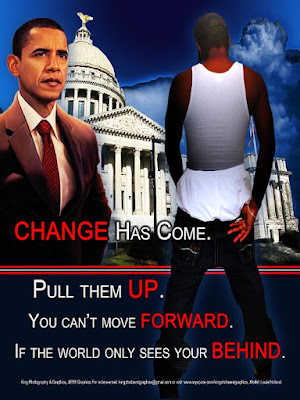
It's apparently the creation of an Atlanta-based designer, King Photography and Graphics. I found it and two other posters like it on www.nomoresagging.com. It dovetails nicely with a question I raised a few months back about Obama's impact on black culture. Although he's personally weighed in against the sort of laws against sagging that Atlanta and other places have considered, he did clearly state that he thought wearing them like that was disrespectful of others.
I don't know how much of an impact things like this have now or will have later, but it is an interesting thing to keep an eye on.

It's apparently the creation of an Atlanta-based designer, King Photography and Graphics. I found it and two other posters like it on www.nomoresagging.com. It dovetails nicely with a question I raised a few months back about Obama's impact on black culture. Although he's personally weighed in against the sort of laws against sagging that Atlanta and other places have considered, he did clearly state that he thought wearing them like that was disrespectful of others.
I don't know how much of an impact things like this have now or will have later, but it is an interesting thing to keep an eye on.
Subscribe to:
Posts (Atom)