In a Thai mangrove, fireflies flashed while nearby crickets chirped at almost the same tempo. For a moment it looked like interspecies music: light and sound keeping time. Then the analysis dissolved the romance. The two species were not synchronized. They were not answering one another. They had simply arrived at nearly the same beat.
Showing posts with label science. Show all posts
Showing posts with label science. Show all posts
Wednesday, September 9, 2026
Holding the Cosmic Door Open
Yesterday, the inward spiral and axial stretching in OpenAI’s Navier–Stokes announcement made something click. Its technical paper constructs a smoothly forced fluid flow whose velocity becomes unbounded in finite time while its total kinetic energy remains bounded. Viscosity is still present. The flow concentrates despite it.
My mind went straight to black holes.


Saturday, September 5, 2026
Strongest Evidence Yet (Again)
The LZ paper reports one 248-keV event at 2.6σ global significance—interesting, but explicitly not a discovery. That makes an epistemic angle stronger than the claim that 'dark matter IS found.'
Monday, August 24, 2015
Teaching Ignorance
Interesting piece in the NYT on trying to explain to students that science doesn't erase ignorance, it just creates new landscapes for it to exist:
Science is progressive in that future knowledge builds on erasing the ignorance of the past. The problems and breakthroughs we've made so far empower us to push ever onward in our pursuit of knowledge. We know we can do it again because we've done it before.
The progress science makes sometimes takes a circuitous route to improving our quality of life. The discovery of TDP-43 in ALS, for example, will not cure ALS overnight. As MLK once remarked, the moral arc of the universe is long, but it bends towards justice. Maybe the ignorance-erasing arc of science is long, but it bends constantly towards improving our lives.
The larger the island of knowledge grows, the longer the shoreline — where knowledge meets ignorance — extends. The more we know, the more we can ask.Of course not all ignorance is created equal. Not knowing the motions of the planets, or the root causes of our diseases, is fundamentally different than not knowing where life exists outside of our solar system, or the specific proteins involved in ALS.
Science is progressive in that future knowledge builds on erasing the ignorance of the past. The problems and breakthroughs we've made so far empower us to push ever onward in our pursuit of knowledge. We know we can do it again because we've done it before.
The progress science makes sometimes takes a circuitous route to improving our quality of life. The discovery of TDP-43 in ALS, for example, will not cure ALS overnight. As MLK once remarked, the moral arc of the universe is long, but it bends towards justice. Maybe the ignorance-erasing arc of science is long, but it bends constantly towards improving our lives.
Monday, July 7, 2014
Commitments
When do beliefs and facts collide?
When you decide at the outset that something is true, your commitment may blind you to contrary evidence and rational expectations. Let's compare the intellectual commitments of science versus, say, politics or religion: In science, we presume the uniformity of nature. This means we assume that the laws of gravity, electromagnetism, etc., are fundamental properties of the universe, rather than contingent features that are subject to change. This presumption is useful because it allows us to interpolate and extrapolate data. A simple example would be inferring the age of the earth from geological processes, or isotope decay, or measuring the distance to stars. This premise is very, very difficult to falsify.
And that's the beauty of skepticism: start with very basic assumptions, and continue to question them as new evidence and information arises. Religious belief is quite different for two main reasons: 1) some religions require obedience and faith that is defined as without evidence, and 2) the commitments of religious people are sometimes so complex that they don't even realize how difficult their position is to defend. The first reason is rather clear and doesn't need much elaboration, in the sense that belief in a Garden of Eden or Resurrection or whatever clearly defies common sense and every scientific principle known to man.
When you decide at the outset that something is true, your commitment may blind you to contrary evidence and rational expectations. Let's compare the intellectual commitments of science versus, say, politics or religion: In science, we presume the uniformity of nature. This means we assume that the laws of gravity, electromagnetism, etc., are fundamental properties of the universe, rather than contingent features that are subject to change. This presumption is useful because it allows us to interpolate and extrapolate data. A simple example would be inferring the age of the earth from geological processes, or isotope decay, or measuring the distance to stars. This premise is very, very difficult to falsify.
And that's the beauty of skepticism: start with very basic assumptions, and continue to question them as new evidence and information arises. Religious belief is quite different for two main reasons: 1) some religions require obedience and faith that is defined as without evidence, and 2) the commitments of religious people are sometimes so complex that they don't even realize how difficult their position is to defend. The first reason is rather clear and doesn't need much elaboration, in the sense that belief in a Garden of Eden or Resurrection or whatever clearly defies common sense and every scientific principle known to man.
Sunday, January 5, 2014
The Angel of Death
...has a face that looks a lot more like a malignant neoplasm than a heart attack.
 That's the bottom line from this article at the NYT. The top causes of death are rapidly changing even as we lower the overall mortality rate. Cancer is on the verge of overtaking heart disease. Of course each country and culture will have slightly varying percentages.
As the author astutely points out, cancer is much more complex to "cure" than many other death risk factors. Our cellular machinery has an inbuilt capacity to regenerate tissue and that will always leave the door open for malfunction.

As the author astutely points out, cancer is much more complex to "cure" than many other death risk factors. Our cellular machinery has an inbuilt capacity to regenerate tissue and that will always leave the door open for malfunction.
Sunday, May 12, 2013
Evolution of life
The last time I thought much about abiogenesis, I had a hard time finding good (recent) review articles to summarize things, and relied on the NYT. The past few years have provided many breakthroughs, summarized by Hazen and others. This month's Nature Chemistry has an entire section devoted to the subject. It calls the Grand Challenge of chemistry explaining the emergence of life, similar to a Theory of Everything in physics.
Monday, April 29, 2013
Philosopher's Stone in NYT
I really like a lot of the stuff I read there, and today's reading was no exception:
Kant’s insight was that, in order for the knowledge we get from our senses at any given moment in time to mean anything, our minds must already be distinguishing it and combining it with the information we get in prior and subsequent moments in time. Thus there is no such thing as a pure impression in time — no absolute, frozen moment in which we know the sun is rising now without being able to infer anything from it — because such a pure moment without a before or after would be nothing at all...
Saturday, April 6, 2013
Genius
I found a few interesting resources from this page that I wanted to highlight / bookmark. I am reading through Basic Neurochemistry (Siegel, 8th) right now and am interested as a scientist in the effort to model intelligence based on the brain. There are a lot of variables that people try to plug into equations to predict IQ: brain volume overall, correlations between the amount and/or ratio white matter (myelin sheathing), gray matter, folding, interhemispheric interaction, density, wave patterns...etc.
Now that all this money is supposed to be poured into the Brain Activity Map Project or whatever they'll call it, I just figured I'd put out my prediction:
We tend to think of the brain in computer-related terms. The speed at which it processes information. How its "circuits" are designed and how signals propagate through them. But there is something as a biochemist that leads me to reject the binary on/off nature. Rather than thinking of neurons as in an "on / off" state, and trying to model the brain like a CPU, it is important to realize that the strength of the signal is a function of chemistry. The actual electrochemical potential (voltage) that we are discussing here goes back to the concentration of ions and transmitters. And since this concentration can vary, so can signal strength.
So now imagine trying to model a very simple brain, like C. elegans, studied by Bargmann and others, with only 300 or so neurons. In the simplest computing model, you would have the firing patterns of the neurons mapped so that, for instance, odor recognition lights up a certain portion of the brain in a certain sequence. But this assumes each of these neurons to be in a true "on/off" state. They are more along a spectrum of signal strength. Let's say for simplicities' sake you round off the observed concentrations into 10 brackets (zero, near-zero...near-maximum, maximum). The complexity inherent in mapping 300 different possibilities is exponentially magnified because it isn't 2^300, but instead it is now 10^300. So now you've gone from 2 * 10^90 to 1 * 10^300 possible "states". And if you aren't mathematically inclined, 10^90 is more than the estimated number of atoms in the universe. You would have to assemble 10^200 universes to approach the number atoms equal to the possible states in C. elegans brain.
Where would we put that kind of map, assuming a computer could draw it for us? ;) And do you think that reading it would be any different than an ant reading Melville?
As I've said before, I don't put too much stock in IQ tests that fall within one standard deviation or so from the mean, but I put a lot more in them when the measurement indicates significant outliers. I put zero stock in the effort to link brain activity meaningfully to behavior or intelligence.
Now that all this money is supposed to be poured into the Brain Activity Map Project or whatever they'll call it, I just figured I'd put out my prediction:
We tend to think of the brain in computer-related terms. The speed at which it processes information. How its "circuits" are designed and how signals propagate through them. But there is something as a biochemist that leads me to reject the binary on/off nature. Rather than thinking of neurons as in an "on / off" state, and trying to model the brain like a CPU, it is important to realize that the strength of the signal is a function of chemistry. The actual electrochemical potential (voltage) that we are discussing here goes back to the concentration of ions and transmitters. And since this concentration can vary, so can signal strength.
So now imagine trying to model a very simple brain, like C. elegans, studied by Bargmann and others, with only 300 or so neurons. In the simplest computing model, you would have the firing patterns of the neurons mapped so that, for instance, odor recognition lights up a certain portion of the brain in a certain sequence. But this assumes each of these neurons to be in a true "on/off" state. They are more along a spectrum of signal strength. Let's say for simplicities' sake you round off the observed concentrations into 10 brackets (zero, near-zero...near-maximum, maximum). The complexity inherent in mapping 300 different possibilities is exponentially magnified because it isn't 2^300, but instead it is now 10^300. So now you've gone from 2 * 10^90 to 1 * 10^300 possible "states". And if you aren't mathematically inclined, 10^90 is more than the estimated number of atoms in the universe. You would have to assemble 10^200 universes to approach the number atoms equal to the possible states in C. elegans brain.
Where would we put that kind of map, assuming a computer could draw it for us? ;) And do you think that reading it would be any different than an ant reading Melville?
As I've said before, I don't put too much stock in IQ tests that fall within one standard deviation or so from the mean, but I put a lot more in them when the measurement indicates significant outliers. I put zero stock in the effort to link brain activity meaningfully to behavior or intelligence.
Sunday, February 17, 2013
Really cool Science videos
Title says it all. I wanted to embed them but they seem to have that function disabled. Check out these fantastic videos from Science:
- Fertilization (human)
I'd seen videos of human fertilization depictions before, but this one is breathtaking. AMAZING
They use a pancreatic cell from a mouse to show you the relative 3D scale of the organelles, then switch to a graphical depiction. Really informative and neat.
Sunday, January 6, 2013
Execution is everything
I think my football coach friends can related to this concept very well:
Ideas, in a sense, are overrated. Of course, you need good ones, but at this point in our supersaturated culture, precious few are so novel that nobody else has ever thought of them before. It’s really about where you take the idea, and how committed you are to solving the endless problems that come up in the execution. The more I experienced this frustration firsthand, the more I came to appreciate how naturally suited I am to the job I used to think I never wanted to have when I grew up.It may seem counterintuitive, but I would claim this really applies to scientific research as well, despite that Holy Grail/Eureka mentality of science (e.g., string theory, cancer cures...). It's not that people haven't come up with a number of novel approaches to solving a problem much like your own. It's that they either gave up on them or started working on them to run into a problem that technology has since changed or solved.
Saturday, December 29, 2012
Phases of the moon
As most people know, the month is lunar and the year is solar. But there is no nice 12:1 equivalent in reality, and the months have varying numbers of days. As a result, solar years will contain different numbers of lunar cycles. This year we had the pleasure of seeing 13 full moons; last night (Fri) was the final one. See a cool video showing the moon's cycles below:
Monday, June 14, 2010
Singularity University and Transhumanism
The NYT has an article about transhumanism. I wrote a short piece on the topic back in April 07.
Tuesday, April 13, 2010
Psilocybin
I wrote about two years ago about the interesting research done on psilocybin. The NYT has a great in-depth article discussing the latest research efforts to measure the drug's effects on depression and anxiety. Fundamentally, it has the ability to melt away one's sense of self and this seems to have long-term effects elevating mood and perspective.
Scientists are especially intrigued by the similarities between hallucinogenic experiences and the life-changing revelations reported throughout history by religious mystics and those who meditate. These similarities have been identified in neural imaging studies conducted by Swiss researchers and in experiments led by Roland Griffiths, a professor of behavioral biology at Johns Hopkins.Interesting, and definitely deserving of more follow-up work. What I don't like is this sentiment:
In one of Dr. Griffiths’s first studies, involving 36 people with no serious physical or emotional problems, he and colleagues found that psilocybin could induce what the experimental subjects described as a profound spiritual experience with lasting positive effects for most of them. None had had any previous experience with hallucinogens, and none were even sure what drug was being administered.
To make the experiment double-blind, neither the subjects nor the two experts monitoring them knew whether the subjects were receiving a placebo, psilocybin or another drug like Ritalin, nicotine, caffeine or an amphetamine. Although veterans of the ’60s psychedelic culture may have a hard time believing it, Dr. Griffiths said that even the monitors sometimes could not tell from the reactions whether the person had taken psilocybin or Ritalin.
The monitors sometimes had to console people through periods of anxiety, Dr. Griffiths said, but these were generally short-lived, and none of the people reported any serious negative effects. In a survey conducted two months later, the people who received psilocybin reported significantly more improvements in their general feelings and behavior than did the members of the control group.
The findings were repeated in another follow-up survey, taken 14 months after the experiment. At that point most of the psilocybin subjects once again expressed more satisfaction with their lives and rated the experience as one of the five most meaningful events of their lives.
Since that study, which was published in 2008, Dr. Griffiths and his colleagues have gone on to give psilocybin to people dealing with cancer and depression, like Dr. Martin, the retired psychologist from Vancouver. Dr. Martin’s experience is fairly typical, Dr. Griffiths said: an improved outlook on life after an experience in which the boundaries between the self and others disappear.
In interviews, Dr. Martin and other subjects described their egos and bodies vanishing as they felt part of some larger state of consciousness in which their personal worries and insecurities vanished. They found themselves reviewing past relationships with lovers and relatives with a new sense of empathy.
“It was a whole personality shift for me,” Dr. Martin said. “I wasn’t any longer attached to my performance and trying to control things. I could see that the really good things in life will happen if you just show up and share your natural enthusiasms with people. You have a feeling of attunement with other people.”
The subjects’ reports mirrored so closely the accounts of religious mystical experiences, Dr. Griffiths said, that it seems likely the human brain is wired to undergo these “unitive” experiences, perhaps because of some evolutionary advantage.
“This feeling that we’re all in it together may have benefited communities by encouraging reciprocal generosity,” Dr. Griffiths said. “On the other hand, universal love isn’t always adaptive, either.”
“There’s this coming together of science and spirituality,” said Rick Doblin, the executive director of MAPS. “We’re hoping that the mainstream and the psychedelic community can meet in the middle and avoid another culture war. Thanks to changes over the last 40 years in the social acceptance of the hospice movement and yoga and meditation, our culture is much more receptive now, and we’re showing that these drugs can provide benefits that current treatments can’t.”The problem with that way of thinking is that it treats spirituality as this thing that is separate from the natural operation of our brains. No one doubts that science can study the natural operation of our brains, and so when Doblin describes a "coming together" he implies that there is some supernatural phenomenon that is outside of the purview of science. Bull. Spirituality is simply the mind being what the brain does, and what the brain does is chemistry. The more we learn about brain functions the more we can replicate and induce "spiritual experiences," proving them to be just another natural phenomenon that can be reduced to material causes.
Saturday, December 5, 2009
Outward Bound and the Call of the Wild
I've gone on two Outward Bound 3-4 day group excursions. The trips really recharged me and reminded me of studying the transcendentalists. SciAm has a good article talking about what time out in nature does to us:
On another (completely unrelated) note, SciAm has an article by Shermer talking about skepticism that was really good:
But a recent article by researchers at the University of Rochester shows that experiences with nature can affect more than our mood. In a series of studies, Netta Weinstein, Andrew Przybylski, and Richard Ryan, University of Rochester, show that exposure to nature can affect our priorities and alter what we think is important in life. In short, we become less self-focused and more other-focused. Our value priorities shift from personal gain, to a broader focus on community and connection with others.As people spend less and less time outdoors, I fear we'll see these encouraging results affect smaller portions of the population. I think if we all spent more time in nature that issues like global warming and pollution would be far less polarized. We'd all feel connected to the issues more personally.
To demonstrate this effect, they ran a series of studies. In their first study, the researchers randomly assigned individuals to view a slide show that either depicted scenes of human-made or natural environments. The slides were matched across a variety of characteristics, to eliminate the possibility that the results were due to things like color, complexity, or brightness of the images. The participants were instructed to try to immerse themselves in the images—to notice the colors and textures and imagine the sounds and smells. After watching the slide show (which took about 8 minutes), the participants completed a series of questions about their life aspirations.
Of particular interest were responses to extrinsic life aspirations , like being financially successful or admired by many people; as contrasted with intrinsic life aspirations , like deep and enduring relationships, or working toward the betterment of society. The results showed that people who watched the nature images scored significantly lower on extrinsic life aspirations, and significantly higher on intrinsic life aspirations. The effect was particularly strong for participants who reported being “immersed” in the images. This basic effect was further explored in three subsequent studies. The later studies showed the same effect for true nature experiences: being in a small room with plants, for example.
On another (completely unrelated) note, SciAm has an article by Shermer talking about skepticism that was really good:
So many claims of this nature are based on negative evidence. That is, if science cannot explain X, then your explanation for X is necessarily true. Not so. In science, lots of mysteries are left unexplained until further evidence arises, and problems are often left unsolved until another day. I recall a mystery in cosmology in the early 1990s whereby it appeared that there were stars older than the universe itself—the daughter was older than the mother! Thinking that I might have a hot story to write about that would reveal something deeply wrong with current cosmological models, I first queried California Institute of Technology cosmologist Kip S. Thorne, who assured me that the discrepancy was merely a problem in the current estimates of the age of the universe and that it would resolve itself in time with more data and better dating techniques. It did, as so many problems in science eventually do. In the meantime, it is okay to say, “I don’t know,” “I’m not sure” and “Let’s wait and see.”I want to believe in the cyclic universe, but I'm quite willing to admit that no one knows, and that we may never know with any degree of certainty, how our universe came to be as it is today (although it may have never "come to be" at all).
...Most people (scientists included) treat the God question separate from all these other claims. They are right to do so as long as the particular claim in question cannot—even in principle—be examined by science. But what might that include? Most religious claims are testable, such as prayer positively influencing healing. In this case, controlled experiments to date show no difference between prayed-for and not-prayed-for patients. And beyond such controlled research, why does God only seem to heal illnesses that often go away on their own? What would compel me to believe would be something unequivocal, such as if an amputee grew a new limb. Amphibians can do it. Surely an omnipotent deity could do it. Many Iraqi War vets eagerly await divine action
...There is no positive evidence for [the origin of the universe], but neither is there positive evidence for the traditional answer to the question—God. And in both cases, we are left with the reductio ad absurdum question of what came before the multiverse or God. If God is defined as that which does not need to be created, then why can’t the universe (or multiverse) be defined as that which does not need to be created?
In both cases, we have only negative evidence along the lines of “I can’t think of any other explanation,” which is no evidence at all. If there is one thing that the history of science has taught us, it is that it is arrogant to think we now know enough to know that we cannot know. So for the time being, it comes down to cognitive or emotional preference: an answer with only negative evidence or no answer at all. God, multiverse or Unknown. Which one you choose depends on your tolerance for ambiguity and how much you want to believe. For me, I remain in sublime awe of the great Unknown.
Tuesday, October 13, 2009
Sagan's "Pale Blue Dot"
It's a classic worth remembering from time to time:
Check out this picture:

It's easy to forget that our sun is but one star in the Milky Way galaxy, with billions and billions of other stars inside it. And our galaxy is but one in a universe with hundreds of billions of other galaxies. So the next time you think something really bad happened to you and it's going to ruin your life, just put it in perspective. Cosmic perspective.

Check out this picture:

It's easy to forget that our sun is but one star in the Milky Way galaxy, with billions and billions of other stars inside it. And our galaxy is but one in a universe with hundreds of billions of other galaxies. So the next time you think something really bad happened to you and it's going to ruin your life, just put it in perspective. Cosmic perspective.

Tuesday, September 29, 2009
Quantum weirdness and Bell's theorem
Although I was nearly certain I wrote a post about Bell's Theorem in the summer of 2006, it appears I started a post on it then modified it to talk about Hume and creationism. At some point the post got so long and complex I cut out quantum stuff entirely.
At any rate, Wired has an article explaining that a recently-published study has shown quantum entanglement, which is the heart of Bell's Theorem, on a scale never before seen.
At any rate, Wired has an article explaining that a recently-published study has shown quantum entanglement, which is the heart of Bell's Theorem, on a scale never before seen.
In the new study, researchers used a microwave pulse to attempt to entangle the electrical currents of the two superconductors. If the currents were quantum-mechanically linked, one current would flow clockwise at the time of measurement (assigned a value of 0), while the other would flow counterclockwise when measured (assigned a value of 1), Martinis says. On the other hand, the currents’ directions would be completely independent of each other if everyday, classical physics were at work.Refs:
After attempting to entangle the superconducting circuits, Martinis and his team measured the directions of the currents 34.1 million times. When one current flowed clockwise (measured as a 0), the team found, the other flowed counterclockwise (measured as a 1) with very high probability. So the two were linked in a way that only quantum mechanics could explain.
- "Is the moon there when nobody looks? Reality and the quantum theory" (PDF, 267k), N. David Mermin, Physics Today (April 1985)
- Bell's Theorem with Easy Math, by David R. Schneider
- Quantum Entanglement and Information, Stanford Encyclopedia of Philosophy
Tuesday, July 14, 2009
What a surprise!
Steorn failed. The 1st Law remains intact. What a surprise. I could have never predicted that...
Now we'll just wait and see how those "over unity devices" work out.
Now we'll just wait and see how those "over unity devices" work out.
Monday, June 15, 2009
Summary of abiogenesis breakthroughs
Following up on an item from last month, the NYT has a great summary of the four principal features of new origins-of-life models:
- Discovery of the natural synthesis of fatty acids that spontaneously form membranes
- Discovery of a route of natural formation of nucleotides
- Discovery of RNA enzymes made solely from RNA
- Discovery of a solution to the chiral "problem"
Great stuff. I love learning more about abiogenesis.With these four recent advances — Dr. Szostak’s protocells, self-replicating RNA, the natural synthesis of nucleotides, and an explanation for handedness — those who study the origin of life have much to be pleased about, despite the distance yet to go. “At some point some of these threads will start joining together,” Dr. Sutherland said. “I think all of us are far more optimistic now than we were five or 10 years ago.”
One measure of the difficulties ahead, however, is that so far there is little agreement on the kind of environment in which life originated. Some chemists, like Günther Wächtershäuser, argue that life began in volcanic conditions, like those of the deep sea vents. These have the gases and metallic catalysts in which, he argues, the first metabolic processes were likely to have arisen.
But many biologists believe that in the oceans, the necessary constituents of life would always be too diluted. They favor a warm freshwater pond for the origin of life, as did Darwin, where cycles of wetting and evaporation around the edges could produce useful concentrations and chemical processes.
Thursday, May 14, 2009
One more nail in the coffin
Today's Nature has a splendid and amazing article that will be sure to have a major impact on OOL research for decades:
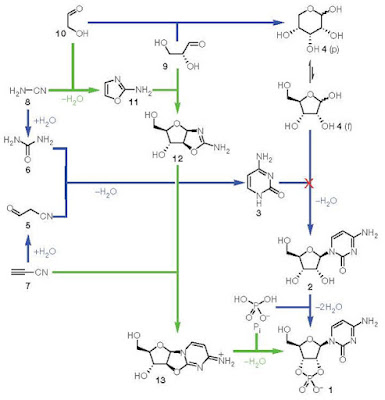
Science is progress. The questions and ignorance that religion is dependent upon to remain in place will continue to be eroded by its inexorable march towards knowledge and understanding. If ever people finally decide to give up on superstition, the coup de grâce to religion will come not from some violent revolution, but in a lab, where it will finally be shown how to take simple prebiotic molecules and construct a protocell capable of evolution. There will still be religious people, just as today there are still Amish despite the prevalence of technology. But they will be fundamentally isolated from the larger world.
... although 'activated' ribonucleotide molecules (the building blocks of RNA) can polymerize without enzymes, no plausible route had been found by which the ribonucleotides could have formed. Now a team from the University of Manchester has found such a route. They also show that a widely held assumption about ribonucleotide synthesis — that the molecules formed from pre-existing sugar molecules and RNA bases — isn't necessary for RNA to have formed on prebiotic Earth.We're now at a point where the existence of a prebiotic RNA World can be explained. See the NYT also.

Science is progress. The questions and ignorance that religion is dependent upon to remain in place will continue to be eroded by its inexorable march towards knowledge and understanding. If ever people finally decide to give up on superstition, the coup de grâce to religion will come not from some violent revolution, but in a lab, where it will finally be shown how to take simple prebiotic molecules and construct a protocell capable of evolution. There will still be religious people, just as today there are still Amish despite the prevalence of technology. But they will be fundamentally isolated from the larger world.
Subscribe to:
Posts (Atom)