Showing posts with label abiogenesis. Show all posts
Showing posts with label abiogenesis. Show all posts
Sunday, May 12, 2013
Evolution of life
The last time I thought much about abiogenesis, I had a hard time finding good (recent) review articles to summarize things, and relied on the NYT. The past few years have provided many breakthroughs, summarized by Hazen and others. This month's Nature Chemistry has an entire section devoted to the subject. It calls the Grand Challenge of chemistry explaining the emergence of life, similar to a Theory of Everything in physics.


Monday, June 15, 2009
Summary of abiogenesis breakthroughs
Following up on an item from last month, the NYT has a great summary of the four principal features of new origins-of-life models:
- Discovery of the natural synthesis of fatty acids that spontaneously form membranes
- Discovery of a route of natural formation of nucleotides
- Discovery of RNA enzymes made solely from RNA
- Discovery of a solution to the chiral "problem"
Great stuff. I love learning more about abiogenesis.With these four recent advances — Dr. Szostak’s protocells, self-replicating RNA, the natural synthesis of nucleotides, and an explanation for handedness — those who study the origin of life have much to be pleased about, despite the distance yet to go. “At some point some of these threads will start joining together,” Dr. Sutherland said. “I think all of us are far more optimistic now than we were five or 10 years ago.”
One measure of the difficulties ahead, however, is that so far there is little agreement on the kind of environment in which life originated. Some chemists, like Günther Wächtershäuser, argue that life began in volcanic conditions, like those of the deep sea vents. These have the gases and metallic catalysts in which, he argues, the first metabolic processes were likely to have arisen.
But many biologists believe that in the oceans, the necessary constituents of life would always be too diluted. They favor a warm freshwater pond for the origin of life, as did Darwin, where cycles of wetting and evaporation around the edges could produce useful concentrations and chemical processes.
Thursday, May 14, 2009
One more nail in the coffin
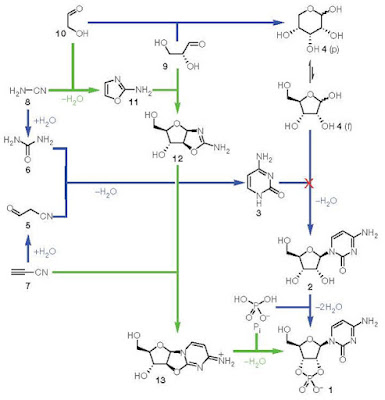
Today's Nature has a splendid and amazing article that will be sure to have a major impact on OOL research for decades:
Science is progress. The questions and ignorance that religion is dependent upon to remain in place will continue to be eroded by its inexorable march towards knowledge and understanding. If ever people finally decide to give up on superstition, the coup de grâce to religion will come not from some violent revolution, but in a lab, where it will finally be shown how to take simple prebiotic molecules and construct a protocell capable of evolution. There will still be religious people, just as today there are still Amish despite the prevalence of technology. But they will be fundamentally isolated from the larger world.
... although 'activated' ribonucleotide molecules (the building blocks of RNA) can polymerize without enzymes, no plausible route had been found by which the ribonucleotides could have formed. Now a team from the University of Manchester has found such a route. They also show that a widely held assumption about ribonucleotide synthesis — that the molecules formed from pre-existing sugar molecules and RNA bases — isn't necessary for RNA to have formed on prebiotic Earth.We're now at a point where the existence of a prebiotic RNA World can be explained. See the NYT also.

Science is progress. The questions and ignorance that religion is dependent upon to remain in place will continue to be eroded by its inexorable march towards knowledge and understanding. If ever people finally decide to give up on superstition, the coup de grâce to religion will come not from some violent revolution, but in a lab, where it will finally be shown how to take simple prebiotic molecules and construct a protocell capable of evolution. There will still be religious people, just as today there are still Amish despite the prevalence of technology. But they will be fundamentally isolated from the larger world.
Saturday, July 5, 2008
Summary of origin of life research
I like to write things about abiogenesis. Go here for some great peer-reviewed publications on the origin of the genetic code and the evolution of the chemical processes underlying metabolism.
In a reply to Gordy Slack, Nick Matzke wrote something great at the Panda's Thumb on the same topic and I want to paste in the relevant portion below:
In a reply to Gordy Slack, Nick Matzke wrote something great at the Panda's Thumb on the same topic and I want to paste in the relevant portion below:
An excellent summary, if I may say so. He left out a few things that I've mentioned before, like the discovery of the role of borate in natural ribose synthesis by a colleague of mine at UF, and upstairs neighbors, Alonso Ricardo and Fabianne Frye. Go here for some great peer-reviewed publications on the origin of the genetic code and the evolution of the chemical processes underlying metabolism.Origin of Life (OOL)
Slack lists a “few worthy points” creationists make. Here is the first:
First, I have to agree with the ID crowd that there are some very big (and frankly exciting) questions that should keep evolutionists humble. While there is important work going on in the area of biogenesis, for instance, I think it’s fair to say that science is still in the dark about this fundamental question.
Minor point first: Shallit points out that “biogenesis” means production of life from life, whereas Slack is talking about the origin of life (OOL). Oops.
Major points: PZ says that sure, big exciting unanswered questions like the origin of life exist in science, but scientists said this first, and furthermore consider them research opportunities, not flaws. Shallit separates OOL from evolution, specifying that evolution is what occurs after you have life; Shallit does this in the face of Slack asserting that this response is disingenuous. Shallit also argues a little over whether or not we’ve made only “little progress” in understanding the OOL, but says even if we’ve only made a little progress, it’s better than ID.
This mini-debate points out what I think, and have often said in conversations, is a major flaw in how we respond to creationists. All too often, when the OOL comes up in popular discussions (reporters, online debates, etc.), the anti-creationist will reply with some variation of “sure, it’s a tough unsolved problem, but we’re working on it”, or the wizened statement “actually, the OOL is outside of the domain of evolutionary biology”, or finally, “we’re pretty much in the dark about the OOL, but at least what we have is better than the creationists giving up and saying a miracle occurred.”
My take: It is high time all of these statements be discarded or highly modified. They are basically lazy, all-too-easy responses relying on hair-splitting technicalities or nearly philosophical assertions of the “even if the creationists were empirically correct on this point, which they aren’t but I’m too busy to back it up right now, it wouldn’t matter” variety. And the worst part is that these sorts of statements mis-describe the actual state of the science among the people who work in the field. It is simply not true that we, the scientific community, know almost nothing about the OOL (what an individual who spent a career working on fossils or fruit flies or speciation might know personally is a different question).
Here is a short list of things we have discovered or confirmed in the last 50 years or so pertaining to the origin of life. In my opinion all of these points have reached high enough confidence that they are unlikely to change much with future discoveries, and our confidence in them does not depend in uncertainties in the remaining unanswered questions.
OOL Discovery #1. All known life can be traced back to a single common ancestor which, compared to what most people think of as present-day life (i.e. plants and animals), was relatively simple – microscopic, single-celled, perhaps as complex as an average bacterium or perhaps somewhat less so.
Because a lot of creationists, and sometimes others, are a bit thick in the head on correctly understanding this point, let me bash away at some common misconceptions. The phrase “single common ancestor” does not, and never has for people who were paying close attention, referred to a literal single individual organism. Think about a phylogenetic tree with humans and chimps on the branches. When you trace the tree back to the “common ancestor” of chimps and humans, does that node represent a literal single individual? No, of course not! Everyone (well, everyone paying attention) realizes that that ancestral node represents a species or population sharing genes in a gene pool. Ditto for all of the other ancestral nodes in a phylogenetic tree, including the Last Common Ancestor of known life.
With this understood, the debate initiated by Ford Doolittle and others over the precise nature of the Last Common Ancestor – they argue that it was a population of unicells that were rampantly trading genes – can be put in the correct context. It’s basically a debate about how wide or narrow the bottleneck the Last Common Ancestor represents, and whether (for example) modern life might contain some genes derived by lateral transfer from pre-LCA lineages that are now extinct. These debates are fascinating and highly technical, but they don’t undermine at all Point #1. Somewhat ironically and counterintuitively, those who say that there was rampant lateral transfer – this is supposed to be the “radical” position that “uproots the Tree of Life” when its proponents get their blood up – are actually pushing the LCA to something more and more like a traditional gene pool, i.e. species, i.e. what every other node in a phylogenetic tree represents.
Any way you slice it, all known life (with minor derived exceptions, and excepting viruses) shares a suite of protein and RNA genes, a DNA-RNA-protein system and a mostly standard genetic code (again with minor derived exceptions), etc. Even if various other bits of modern life came from other ancestral lineages (unlikely for most features in my opinion but there may be some exceptions), this shared system indicates that all known life, i.e. all the stuff that’s not extinct, descends from a pretty good bottleneck where these features were fixed in the “population.” And this reconstructed ancestor is maybe as complex as a typical bacterium and probably less so. It could be that in the last 50 years science discovered that known life had for-real multiple origins, or that at the root of the tree was a complex multicellular organism with 30,000 genes and huge, elaborately regulated, genome, but instead we get a unicell with a relatively small & simple genome. Various caveats, important to scientists but irrelevant to beginner-level education and dealing with creationists (e.g., somewhat more genes may have been passed through the bottleneck in some but not all organisms if the LCA was more of a gene-trading community) should not be allowed to distract from the Main Point: science has confirmed the hypothesis, going back at least to Darwin, that the ancestor of modern life was much less complex than life today.
OOL Discovery #2. The Last Common Ancestor itself was the product of evolution from an even simpler ancestor. The simplest piece of evidence for this is that a number of the genes found in the Last Common Ancestor are homologous, thus derived from a single common ancestor by duplication and modification. An example is the F1Fo-ATPase of bacteria, which interconverts proton gradients (or sometimes sodium ion gradients, which are chemically very similar) and ATP, the main energy currency of cells. It has relatives in all branches of life: the V1Vo-ATPases in eukaryotes (and some prokaryotes), and the A1Ao-ATPases of archaea, and phylogenetic analysis indicates that this membrane-embedded system was found in the LCA (this also confirms that the LCA had membranes, which is useful although already very likely on multiple grounds).
Anyway, the bit of the V/F/A-ATPases that deals with ATP is a heterohexamer, i.e. complex of six proteins (that’s the “hexamer” bit) of two different types (thus “hetero”), cleverly named alpha and beta. The alphas and betas alternate in the six-protein ring, and the betas interact with ATP. The key point here is that the alpha and beta subunits share statistically strong sequence similarity. The simple explanation is that the heterohexamer was descended from a homohexamer made up of six identical proteins forming a ring. Thus we know – as strongly as we know that two people are related by ancestry based on DNA sequence similarity – that long before the last common ancestor of life there was a cellular organism that had something like the F1Fo-ATPase, but a simpler version with a homohexameric ATPase complex instead of a heterohexamer.
This may seem like a trivial point by itself but it is just an example; there are dozens, perhaps hundreds, of others. The evolution of ATPases can be traced much further back: the next closest relative is a homohexamer found in, of all things, the core of the bacterial flagellum and the nonflagellar type 3 secretion systems. Thus the V/F/A-ATPases and the flagellar/nonflagellar type 3 secretion systems can be traced back to an ancestral membrane-associated complex with multiple shared proteins (because the V/F/A-ATPases and type 3 secretion systems shared not just the ATPase protein but also an associated external stalk protein, FliH/Fo-b, which by the way is something I pretty much predicted in 2003 in the Big Flagellum Essay and which Mark Pallen and colleagues nailed down for real in the peer-reviewed literature in 2006).
Even more distant relatives are known: the homohexameric rho (involved in bacterial RNA processing) and homohexameric RecA (DNA processing). And there are even more distant hexameric sister groups; the whole related set of proteins is known as the AAA ATPases if you want to look them up. And if memory serves there are yet more distant non-hexameric relatives.
In other words, the Last Common Ancestor had a suite of ATPase proteins which had already evolved from a single protein ancestor by duplication and divergence events which are still strongly statistically detectable in the present day. And there are a number of other genes for which the same can be said, and undoubtedly many others which occurred but are not statistically detectable billions of years later due to the decay of the signal.
So far we’ve established that anyone, creationist, evolutionist, or whomever, who says that the scientific understanding of the origin-of-life is chemicals –> mystery –> modern-complexity life doesn’t know the first thing about what they’re yapping about. At the very least we’ve got chemicals –> mystery –> quite simple precursor to the LCA –> LCA –> modern life. But there is yet more that we know
OOL Discovery #3. DNA/RNA/protein-based life was preceded by something even simpler, an RNA world or at least an RNA-heavy world.
The RNA world has gotten better press attention than OOL Discoveries #1 and #2 so I will spend less time on it. Read the wikipedia page for an introduction and particularly the EvoWiki page for some of the main supporting evidence.
There are two points worth making about the RNA world that should be made every time this issue is discussed in popular or remedial creationism-related discussions. First: there was a time, not too long ago, when the fact that DNA coded for proteins, and proteins were necessary for making DNA, seemed like the ultimate intrinsically unsolvable problem in the study of the origin of life. It’s the ultimate chicken-and-egg problem, or, if you like, the ultimate “irreducible complexity” problem. And yet, scientists worked on it for a few decades and discovered a workable, surprisingly simple solution.
Second, surprisingly enough (well, surprising to creationists or the naive), this solution, the RNA world, hasn’t just sat around as a purely theoretical just-so story. A highly productive research program has been built on the RNA World concept. Areas that have experienced substantial success in the last decade or two include: the discovery of increasingly diverse catalytic capabilities of RNA; the evolution new capabilities in replicating, evolving RNAs; the evolution of the genetic code which translates DNA to RNA to protein; and the prebiotic origin of RNA components.
Each of these areas has developed into a subfield which has experienced major research discoveries in recent years. For example, on the origin of the genetic code, this paper assembles dozens of indicators on the order in which amino acids were added, step-by-step, to the genetic code and shows that the evidence strongly supports a fairly specific scenario (which shares many similarities with early, more speculative scenarios built on the basis of just a few lines of evidence).
Ergo, we don’t just know that the Last Common Ancestor of Life was simple, and that it’s ancestor was simpler, and that it’s ancestor was an even simpler RNA-dominated critter; we even have a decent idea about the order of the steps by which the genetic code itself evolved.
OOL Discovery #4. The increasingly simple ancestors of modern life weren’t made out of just anything, they were made out of chemicals that just happen to be generated by plausible abiotic mechanisms found in early solar systems. This area is also better known, but many, both creationists and scientists and journalists who haven’t thought about it enough, tend to think of prebiotic chemistry as the beginning and ending of origin-of-life studies, and for some extremely foolish reason which I can’t fashion, probably simple carelessness, tend to think that until chemists pop life out of a test tube then we “know nothing” about the origin of life.
Here’s a short list of discoveries about prebiotic chemistry, all of which increase our confidence in the idea that the origin of life was a gradual process, from abiotic chemicals to simple replicators to the simple ancestors of modern life which were discovered above. I’ll include some subtleties that I’ve seen lead people astray on occasion.
* Water is one of the most common compounds in the universe, and was/is common in the solar system (subtlety: most of it is frozen, but remember that on any planet with hot stuff inside and cold frozen stuff outside will have a just-right region in-between where water will be liquid)
* Earthlike planets are likely reasonably common (subtlety: we haven’t discovered them directly yet, but this is isn’t because they aren’t there, it’s because our instruments are at present only sensitive enough to detect big, close-in planets around other stars. Nevertheless, the distribution of the stuff we can detect strongly indicates that there are plenty of earthlike planets in earthlike orbits which will be discoverable in the near future. That’s a prediction, scientists will test it, that’s science for you. Remember that back in the 1990s, ID proponent William Dembski was skeptical of the whole idea of extrasolar planets. Whoops!)
* Amino acids are easy to generate by a variety of processes, and this is not only supported by experiment, but by observation of amino acids in meteorites and other extra-terrestrial material. (Subtlety: There is a body of serious scientific thought which suggests that the Earth’s early atmosphere was more neutral and less reducing than was thought a few decades ago, but (1) this isn’t for sure, the redox chemistry of the Earth’s rocks and atmosphere is a complex business (and I wonder if the impact which produced the moon, removing much of the mantle but leaving the Earth enriched in heavy iron might have made the Earth’s atmosphere more reducing, at least early on – comments?); (2) even in a neutral atmosphere/ocean system there will be locally reducing conditions – heck, there are local reducing conditions here on earth right now even with our heavily oxidized crust and atmosphere; (3) as it turns out, even neutral atmospheres can produce amino acids in respectable yields anyway; and (4) this whole sub-debate is somewhat moot since we have direct evidence of amino acids forming in the solar system e.g. in meteorites.)
* RNA precursors are somewhat tougher, but there has been progress in that area also, and anyway there is no requirement that the first replicator must have been RNA; various other simpler “worlds” have been suggested and are being explored (PNA, peptide nucleic acids; other NAs of various sorts; and lipid worlds, which have the distinct charm of instant replication ability and statistical inheritance, with daughter bubbes containing a subsample of the chemicals making up the mother bubbles, and growth occuring by incorporation of lipids from the environment and other bubbles; so maybe the first “replicators” were even simpler than some have thought).
* The main energy source of present life is ATP and other energized phosphate molecules. So, what was the prebiotic source of those? It turns out that inorganic polyphosphates (chains like phosphate-phosphate-phosphate-phosphate) have energetic bonds very similar to those of ATP (which is adenine-phosphate-phosphate-phosphate), and yet can be formed by the simple heating of certain rocks.
* Less well-known is the fact that prebiotic origins of many cofactors and other universal small biotic compounds have also been reconstructed
What is actually being worked on. The above should convince you that the idea that we know nothing or very little about the OOL is just uninformed foolishness. The field has made major progress. There are some famous puzzles remaining, but they do not add up to “we know nothing about the origin of life.” Furthermore, some of the puzzles that creationists, and sometimes others, consider to be major hangups, are not necessarily so. For example:
* The origin of chirality (the left-handedness of amino acids). This is a major puzzle if you make the extremely foolish and unthinking assume (like creationists do, but sometimes others) that the first use of amino acids in early life was supposed to be in long amino acid chains made up of 100+ amino acids randomly assembled from an even mixture of 20+ different amino acids with an even mixture of right- and left-handed amino acids. But over here in the real world, where the origin of the genetic code has been reconstructed in some detail, we know the following: the first primitive genetic code used just one or a few amino acids, and one of the first was glycine, which is the simplest amino acid, the most common amino acid produced in prebiotic experiments, and which is achiral (no left-hand/right-hand difference) to boot. If, as has been proposed, the first use of amino acids was as something relatively prosaic, i.e. a short chain of hydrophobic residues to insert into an early membrane, then (a) the odds of getting 10 or so amino acids at once that were either left-handed or glycine were not small at all, and (b) it wouldn’t have mattered much if the occasional right-handed amino acid was incorporated, because the crude chemical property of hydrophobicity is all that is really important, and (c) therefore the origin of a preferred chirality could have been more or less random. There is some very interesting work indicating that nature has various processes which might increase the proportion of left-handed amino acids, but it’s not at all clear that these will be necessary to explain chirality.
* The origin of the first replicator. This really is the big cahuna of the OOL discussion, and where the big and contentious debates are still occurring within science, but again I find that many discussants operate with very crude and naive assumptions about what early replicators “should” have been like and what prebiotic experiments “should” be able to produce to “solve” this problem. It’s a mini-version of the “produce a modern cell in a test tube for me or you haven’t solved the OOL” silliness, i.e., “produce a self replicating RNA World, with duplicating ‘informational genetic sequences’ in the test tube, and until you do you can’t say we know anything about the origin of replicators.”
Again, over here in reality-land the distinctions between replicators and nonreplicators are not so clear. I have already mentioned “lipid-world” ideas and the concept of “statistical inheritance”, where overall chemical properties are transmitted or accumulated, without the need for exact inheritance of a sequence. Similar concepts have been applied by OOL workers to amino acid and nucleic acid “sequences”, where before exact inheritance of sequence is acheived, there might have been a stage where inexact incorporation of a range of chemically similar bases was occurring.
Another subtlety is the difference between “self-replication” and processes where prebiotic compounds go through a series of chemical processes, and differences in chemical kinetics increase the frequency of compounds that have more rapid kinetics; if these compounds are auto-catalytic, they can begin a feedback system where chemicals with higher kinetics take over in a proto-selection system. Strangely, although everyone who takes college chemistry learns that the product of chemical reactions is a combination of thermodynamics and kinetics, many discussions of the OOL from scientists, and all of the derivative critiques by creationists, have focused on thermodynamics. This is particularly odd since self-replication is the ultimate example of kinetics overwhelming thermodynamics.
What’s the point of this sub-discussion? Well, if it is the case that the origin of the first “replicator” was, like everything else we’ve discovered in the study of OOL, a slow, gradual (meaning step-by-step), cumulative process, then it is pretty foolish to have in our heads the idea that OOL experiments should produce full-on replicators in one go to be successful experiments. This is basically a strawman expectation that expresses conceptual confusion about what an evolutionary origin of life “should” look like.
(As an aside, I think biology education would be a lot better off if the above points were consistently made in science curricula and textbooks at the high school and college level. Teaching OOL as a story from simple to complex, rather than a detective story from complex to simple, is probably a mistake if the goal is to get students to understand why scientists think the way they do about these issues.)
The Main Point
Now that we’ve briefly reviewed the OOL field and discussed the major discoveries and some of the common misconceptions, let’s return to the statements I quoted at the beginning. Is it really true that “science is still in the dark” on the OOL, as Slack said? Not a chance. If we lived in a world where it actually looked like the first living things were as complex or more complex than life today, or where the last common ancestor contained absolutely no evidence of an evolutionary history, or where big obvious puzzles like the interdependency of DNA/RNA/protein had no hint of solution, or where the building blocks of life were completely unrelated to those produced in prebiotic experiments – all of these things would be true, say, on a robotic planet without microscopic life, where robots were replicated by macroscopic assembly performed by other robots, and powered by hooking up to a grid of fusion-fueled power plants – then we could say “science is still in the dark” on the origin of this robotic biosphere. But instead, we have numerous lines of evidence all pointing towards the notion that current life descends from a relatively simple ancestor, and that ancestor descends from a series of even simpler ancestors. Why should any of this evidence exist, if life was poofed into existence all in one step, which is what the creationists/IDers think happened even when they won’t admit it, because they are not brave enough to defend what they actually think? Additionally, why should the remaining puzzles, particularly about the origin of the first replicator, cause any unusual amount of discomfort for scientists? Whether or not that puzzle is solved, the gap between prebiotic experiments and the first replicators (or better yet, pseudoreplicators with statistical inheritance) is a drastically reduced vestige of a gap compared to what the gap looked like in, say, 1950. When you think about it, the creationists’ attempt to insert miraculous divine intervention into this tight little gap which is left is actually pitiful, and a pretty sad commentary on the state that creationism/ID has been reduced to. The verse “And God said, let the NA precursors link together into a short noncoding kinetically favored chain and pseudoreplicate approximately statistically after their kind” just doesn’t have the same ring to it.
Similarly, if my characterization of the state of the science is accurate, then it is highly irresponsible for scientists to address creationist arguments about the origin of life with statements like, “even if the creationists were empirically correct on this point, which they aren’t but I’m too busy to back it up right now, it wouldn’t matter” or “actually, the OOL is outside of the domain of evolutionary biology.” The first statement surrenders without argument a favorite bogus creationist talking point, and so confirms and passes on their misinformation, even if the evolution “wins” the argument in his own head on some broader philosophical point. Instead of putting the creationist back on his heels with a wave of contradictory evidence, that sort of response, even if the philosophical point is valid, leaves the creationist and any of his sympathetic readers irate that the empirical point is not being addressed, and that the creationist/ID position is being excluded by the rules of the game. The fact that this sort of response is a lot easier and faster to put together does not make it the best one.
The second statement, splitting the OOL from evolutionary theory, is only technically correct in a sort of legalistic, hairsplitting way. Sure, it’s true that technically, “evolution” only happens once you have life, or at least replicators, but getting from replicators to the last common ancestor is most of what most people think about when they’re thinking about the origin of life, i.e., “where did the evolutionary ancestor of all life today come from?” and all of that is evolution all the way. Furthermore, even the origin of the first classical “replicator” was itself very likely an evolutionary process, in that it occurred in stepwise fashion and not all-at-once, and that the first replicator was likely preceded by various sorts of pseudoreplication, statistical inheritance and kinetic biases. If you remove evolution from your thinking about the origin of the first replicator then it is very likely you will never understand how it happened, or what the current research on the question is about. Finally, even apart from these detailed considerations, “evolution” reasonably has a broader meaning – the evolution of the universe, the solar system, the planet, and the planet’s geochemistry, and the origin of life and the origin of the first replicator must be understood as part of that larger evolutionary history.
One other telling point is that the statement “but the OOL is outside of evolutionary theory” response also has the problem of simply dodging the hard work of describing the discoveries and work of modern science, a problem I have already described. In conclusion, if it were up to me, I would completely scrap this statement from the rhetorical toolkit of evolution defenders.
The OOL topic turned into an essay on its own, but we still have another few of Slack’s points to address.
Monday, June 16, 2008
Exploring Life's Origins
I like to write things about abiogenesis.
The Boston Museum of Science has a wonderful new online exhibit called Exploring Life's Origins on the topic, so check it out!
The History Channel will air a show, How Life Began, tonight at 9 PM...the show's schedule:
The Boston Museum of Science has a wonderful new online exhibit called Exploring Life's Origins on the topic, so check it out!
The History Channel will air a show, How Life Began, tonight at 9 PM...the show's schedule:
- Monday, June 16 09:00 PM
- Tuesday, June 17 01:00 AM
- Saturday, June 21 10:00 PM
- Sunday, June 22 02:00 AM
- Sunday, June 29 02:00 PM
Tuesday, April 22, 2008
Abiogenesis in ice
I love to use our library's resources during break.
About two months ago, I read this great article on abiogenesis in ice in Discover magazine: "Did Life Evolve in Ice?"
Of all the recent things I've read about abiogenesis, this is one of the better ones from a chemist's perspective. The crux is that even though the kinetics of reactions slow down at low T, the entropy is low and concentrations are increased by the formation of pockets within ice crystals:
About two months ago, I read this great article on abiogenesis in ice in Discover magazine: "Did Life Evolve in Ice?"
Of all the recent things I've read about abiogenesis, this is one of the better ones from a chemist's perspective. The crux is that even though the kinetics of reactions slow down at low T, the entropy is low and concentrations are increased by the formation of pockets within ice crystals:
This is the main argument against Miller’s experiment, and against a cold origin of life in general. But strange things happen when you freeze chemicals in ice. Some reactions slow down, but others actually speed up—especially reactions that involve joining small molecules into larger ones. This seeming paradox is caused by a process called eutectic freezing. As an ice crystal forms, it stays pure: Only molecules of water join the growing crystal, while impurities like salt or cyanide are excluded. These impurities become crowded in microscopic pockets of liquid within the ice, and this crowding causes the molecules to collide more often. Chemically speaking, it transforms a tepid seventh-grade school dance into a raging molecular mosh pit.
“Usually as you cool things, the reaction rates go down,” concluded Leslie Orgel, who studied the origins of life at the Salk Institute in La Jolla, California, from the 1960s until his death last October. “But with eutectic freezing, the concentrations go up so fast that they more than make up” for the difference.
Cyanide is a good candidate as a precursor molecule in the life-in-a-freezer model for several reasons. First, planetary scientists suspect that cyanide was abundant on early Earth, deposited here by comets or created in the atmosphere by ultraviolet light or by lightning (once the atmosphere became oxygen rich, 2.5 billion years ago, the process would have stopped). Second, although cyanide is lethal to modern animals, it has a convenient tendency to self-assemble into larger molecules. Third, and perhaps most important, no matter how much cyanide rained down, it could become concentrated only in a cold environment—not in warm coastal lagoons—because it evaporates more quickly than water.
Monday, July 9, 2007
New NAS Report on Astrobiology & Abiogenesis
**Update: Carl Zimmer remarks on this in the NYT
___
A new National Academies of Sciences publication, The Limits of Organic Life in Planetary Systems, can be read for free in HTML at the site, or downloaded as a .pdf after login. The executive summary may be downloaded here as a .pdf (and the entire book here as a .pdf (1.1MB), if you're too lazy to login and do it yourself). I'm reposting some earlier material on abiogenesis, evolution and the origin of the genetic code below, with updated links that were previously broken.
___
A new National Academies of Sciences publication, The Limits of Organic Life in Planetary Systems, can be read for free in HTML at the site, or downloaded as a .pdf after login. The executive summary may be downloaded here as a .pdf (and the entire book here as a .pdf (1.1MB), if you're too lazy to login and do it yourself). I'm reposting some earlier material on abiogenesis, evolution and the origin of the genetic code below, with updated links that were previously broken.
Repost:
I have compiled a very useful list of papers (continually revised), covering abiogenesis, the evolution of genetic information, the origin of the genetic code, and human evolution. I will list some of those papers below.
For more on the evolution of information in the genome:
________________
Technorati tags: Abiogenesis, Intelligent Design, Evolution, Creationism
I have compiled a very useful list of papers (continually revised), covering abiogenesis, the evolution of genetic information, the origin of the genetic code, and human evolution. I will list some of those papers below.
For more on the evolution of information in the genome:
- Natural selection as the process of accumulating genetic information in adaptive evolution, M. Kimura, Genetic Research Cambridge, 2 (1961) 127-140
- Rate of Information Acquisition by a Species subjected to Natural Selection, D.J.C. MacKay, open-source @ http://arxiv.org/, (1999)
- Evolution of biological information, T.D. Schneider, Nucleic Acids Research, (2000), 2794-2799
- The fitness value of information, C.T. Bergstrom and M. Lachmann, open-source @ http://arxiv.org/, (2006)
- Review of W. Dembski’s No Free Lunch, J. Shallit, BioSystems, 66 (2002) 93-99
- The Evolution and Understanding of Hierarchical Complexity in Biology from an Algebraic Perspective, C.L. Nehaniv and J.L. Rhodes, Artificial Life, 6 (2000) 45–67
- On the Increase in Complexity in Evolution I, P.T. Saunders and M.W. Ho, Journal of Theoretical Biology, 63 (1976) 375-384
- On the Increase in Complexity in Evolution II: The Relativity of Complexity and the Principle of Minimum Increase, P.T. Saunders and M.W. Ho, Journal of Theoretical Biology, 90 (1981) 515-530
- "Selection, history and chemistry: the three faces of the genetic code.", Trends in Biochemical Sciences, Volume 24, Issue 6, 1 June 1999, Pages 241-247 (full-text .pdf)
- "Genetic code: Lucky chance or fundamental law of nature?", Physics of Life Reviews, Volume 1, Issue 3, Dec 2004, Pages 202-229 (full-text .pdf) [low-quality pub, but expansive overview of the subject]
- "Stepwise Evolution of Nonliving to Living Chemical Systems.", Origins of Life and Evolution of the Biosphere, Volume 34, Issue 4, Aug 2004, Pages 371–389 (full-text .pdf)
- "The Origin of Cellular Life.", Bioessays, Volume 22, Issue 12, Dec 2004, Pages 1160-1170 (full-text .pdf)
- "The Origin of the Genetic Code: Theories and Their Relationships, A Review.", Biosystems, Volume 80, Issue 2, May 2005, Pages 175-184 (full-text .pdf)
- "The Origin and Evolution of the Genetic Code: Statistical and Experimental Investigations.", Robin D. Knight, Ph.D. Dissertation, June 2001.
- Understanding the recent evolution of the human genome: insights from human-chimpanzee genome comparisons, Human Mutation, 28(2):99-130, Oct 2006, Download PDF
- The origin of new genes: Glimpses from the young and old, Nature Reviews Genetics, 4(11): 865-875 Nov 2003, Download PDF
- Evolution of biological complexity, PNAS, 97(9):4463-4468, April 2000, Download PDF
________________
Technorati tags: Abiogenesis, Intelligent Design, Evolution, Creationism
Friday, March 16, 2007
On the Origin of the Genetic Code and Abiogenesis
**Update (11/25/07): See here for updated links for all the papers below**
A new research paper in Science demonstrates yet more evidence for abiogenesis -- finally a 3D map of the chemical structure of a beautiful example of a ribozyme, one which researchers built "from scratch" and could very easily have evolved naturally under the right chemical conditions. See the EurekAlert!, and a perspective on the research:
A very recent case-in-point is shown by Dr. Michael Egnor's rejection of evolution on the basis of a half-baked conception of evolution's inability to generate biological "information," which I refuted with peer-reviewed resources here. After reading Orac shredding the fallacies propounded by Dr. Michael Egnor, and especially the, "Duh, I don't know or understand this, so it must not be true!" (classic argumentum ad ignorantium), I wanted to highlight his section on the origin of the genetic code:
The bar of evidence would continue to be elevated, just as Behe demonstrated with respect to the immune system (blood clotting cascade = BCC, irreducible complexity = IC):
What knowledge do they produce? What cures do they offer? What technology have they manufactured? None. Nada. Zilch. They deal only in ignorance. They give nothing in the way of evidence or argument, and ask for the world in return. When mountains of evidence are presented to them, like in the papers above, they ignore them and dodge the facts entirely.
All they offer are bad arguments against evolution, distortions of facts, and philosophical pleas based on unsound premises. Their desperation is evidenced clearly by the depths to which they descend in order to preserve their silly superstitious religious beliefs. And desperate they ought to be, because evolution has irreparably demolished the validity of the ancient creationist myths forever.
________________
Technorati tags: Intelligent Design, Evolution, Creationism
A new research paper in Science demonstrates yet more evidence for abiogenesis -- finally a 3D map of the chemical structure of a beautiful example of a ribozyme, one which researchers built "from scratch" and could very easily have evolved naturally under the right chemical conditions. See the EurekAlert!, and a perspective on the research:
As the gaps in our knowledge continue to close, the "god of the gaps" continues to shrink along with them. This is as true today of the "Intelligent Design" creationism movement as it was of Young Earth Creationists and their pseudo-scientific arguments against evolutionary biology.No known RNA enzyme in biology catalyzes the polymerase-like joining of RNA. However, the powerful methods of in vitro evolution have made it possible to generate such enzymes from scratch, starting from a large population of RNAs with random sequences (6). The usual approach is first to evolve an RNA enzyme that is an RNA ligase, which can join two oligonucleotides in a template-directed manner. Then, through further evolution, the researcher attempts to coax the ligase to accept NTPs as substrates and to add multiple NTPs in succession.
Bartel and colleagues (7) have used one such in vitro evolved ligase, the class I ligase, and evolved it further to polymerize as many as 14 successive NTPs with high fidelity. Despite valiant efforts, however, it appears unlikely that this particular polymerase enzyme will ever be evolved to the point that it can copy RNA molecules as long as itself (~200 nucleotides). Nonetheless, it is likely that scientists will eventually apply a similar approach to a different set of RNA molecules to achieve more extensive polymerization and ultimately complete replication.
A very recent case-in-point is shown by Dr. Michael Egnor's rejection of evolution on the basis of a half-baked conception of evolution's inability to generate biological "information," which I refuted with peer-reviewed resources here. After reading Orac shredding the fallacies propounded by Dr. Michael Egnor, and especially the, "Duh, I don't know or understand this, so it must not be true!" (classic argumentum ad ignorantium), I wanted to highlight his section on the origin of the genetic code:
I'll agree that how the genetic code evolved is indeed a very good scientific question, but it is a question that in no way poses a threat to current evolutionary theory or requires the postulation of some sort of intelligence to explain. Indeed, it's a hot topic of research for evolutionary biologists, with computer simulations evaluating the plausibility of various explanations and competing hypotheses being tested scientifically. If you search PubMed, you'll find over 5,000 articles about or touching on the evolution of the genetic code, and PubMed doesn't even index many evolutionary biology journals in which such articles would be expected to appear. Indeed, there was a rather interesting paper in PNAS in November about how the universal genetic code may have emerged as determined by studying of transfer RNAs. It also seems to me that Egnor also sounds almost Lamarckian in the way he describes how animals evolve thicker coats in response to cold climate. He also seems not to have considered that the very fact that the genetic code is very nearly universal for all organisms can also be viewed as supporting evolution. If the development of the genetic code appeared very early in the history of life, that would go a long way towards explaining why nearly all life, from bacteria to humans, uses the same code, and even the variants of the genetic code that exist are minor.Indeed. In addition to these papers, I wanted to highlight six other recent reviews that give a great overview of the present scientific thinking towards the origin of the genetic code:
- "Selection, history and chemistry: the three faces of the genetic code.", Trends in Biochemical Sciences, Volume 24, Issue 6, 1 June 1999, Pages 241-247 (full-text .pdf)
- "Genetic code: Lucky chance or fundamental law of nature?", Physics of Life Reviews, Volume 1, Issue 3, Dec 2004, Pages 202-229 (full-text .pdf) [low-quality pub, but expansive overview of the subject]
- "Stepwise Evolution of Nonliving to Living Chemical Systems.", Origins of Life and Evolution of the Biosphere, Volume 34, Issue 4, Aug 2004, Pages 371–389 (full-text .pdf)
- "The Origin of Cellular Life.", Bioessays, Volume 22, Issue 12, Dec 2004, Pages 1160-1170 (full-text .pdf)
- "The Origin of the Genetic Code: Theories and Their Relationships, A Review.", Biosystems, Volume 80, Issue 2, May 2005, Pages 175-184 (full-text .pdf)
- "The Origin and Evolution of the Genetic Code: Statistical and Experimental Investigations.", Robin D. Knight, Ph.D. Dissertation, June 2001.
The bar of evidence would continue to be elevated, just as Behe demonstrated with respect to the immune system (blood clotting cascade = BCC, irreducible complexity = IC):
The BCC arguments can be found throughout IDC websites. One of the most well-informed responders to these arguments is Andrea Bottaro. Last year, as more evidence came in that transposons were involved in the human immune response, Dr. Bottaro put together the pieces and completely refuted the claim of IC as it applies to BCC. How did Prof. Behe respond? By moving the goalposts -- not in any way denying the evidence, but demanding a mutation-by-mutation account of the pathways involved. Thus, he undercuts his own argument by rendering the burden of proof unattainable by any scientific pursuit.Creationists will continue to place ridiculous burdens of proof upon science, while completely refusing to provide positive evidence of their own (because, of course, they have none). Their arguments are, 99.9% of the time, anti-evolutionary in nature, because there are no sound pro-creationism arguments. And, as Judge Jones articulately pointed out, this fallacy of logic is the false dilemma: "If you're wrong, then I'm right."
The court in McLean stated that creation science rested on a "contrived dualism" that recognized only two possible explanations for life, the scientific theory of evolution and biblical creationism, treated the two as mutually exclusive such that "one must either accept the literal interpretation of Genesis or else believe in the godless system of evolution," and accordingly viewed any critiques of evolution as evidence that necessarily supported biblical creationism.Typical creationist stupidity.
What knowledge do they produce? What cures do they offer? What technology have they manufactured? None. Nada. Zilch. They deal only in ignorance. They give nothing in the way of evidence or argument, and ask for the world in return. When mountains of evidence are presented to them, like in the papers above, they ignore them and dodge the facts entirely.
All they offer are bad arguments against evolution, distortions of facts, and philosophical pleas based on unsound premises. Their desperation is evidenced clearly by the depths to which they descend in order to preserve their silly superstitious religious beliefs. And desperate they ought to be, because evolution has irreparably demolished the validity of the ancient creationist myths forever.
________________
Technorati tags: Intelligent Design, Evolution, Creationism
Tuesday, January 16, 2007
Mutually Exclusive Ideologies
Two things that can only exterminate one another:
Technorati tags: God, Religion, Church-state, Philosophy
- Scientific progress (a .pdf primer on astrobiology)-- HT: Bad Astronomy
- Theocratic regress (a Harper's article on Fundy-driven historical revisionism by Jeff Sharlet) -- HT: Hallq
Technorati tags: God, Religion, Church-state, Philosophy
Tuesday, November 21, 2006
Should Science Tell Us the Greatest Story Ever Told?
True or False:
It's a difficult thing, in my view, to say what the role of science is, insofar as "encouraging itself". Science is a method to knowledge, and it is also embodied in who scientists are, to some degree. Religion is not a method to knowledge, it's circumvention of justified knowledge via belief.
If people want justified knowledge, then encouragement is not necessary. Some people don't seem to want it at all, preferring their cherished hopes and dreams over the sometimes cold facts of the natural universe.
I don't know if the inherent nature of science is evangelical, or if it should be. Perhaps if we lived in a better world, the people whose ignorance and fear keeps them from accepting the reality of scientific knowledge and progress would not have to be "converted", because their fear and ignorance wouldn't exist in the first place.
But we don't live in the best of possible worlds, do we?
I am already an athevangelical, I suppose I can become a scientangelical as well ;-)
________________
Technorati tags: Science, Religion
...in a world dangerously charged with ideology, science needs to take on an evangelical role, vying with religion as teller of the greatest story ever told...(link)Well, you already know what I think -- tell the story that's true, ergo, not religious ones.
November 21, 2006__________________
New York Times
A Free-for-All on Science and Religion
By GEORGE JOHNSON
Maybe the pivotal moment came when Steven Weinberg, a Nobel laureate in physics, warned that “the world needs to wake up from its long nightmare of religious belief,” or when a Nobelist in chemistry, Sir Harold Kroto, called for the John Templeton Foundation to give its next $1.5 million prize for “progress in spiritual discoveries” to an atheist — Richard Dawkins, the Oxford evolutionary biologist whose book The God Delusion is a national best-seller.
Or perhaps the turning point occurred at a more solemn moment, when Neil deGrasse Tyson, director of the Hayden Planetarium in New York City and an adviser to the Bush administration on space exploration, hushed the audience with heartbreaking photographs of newborns misshapen by birth defects — testimony, he suggested, that blind nature, not an intelligent overseer, is in control.
Somewhere along the way, a forum this month at the Salk Institute for Biological Studies in La Jolla, Calif., which might have been one more polite dialogue between science and religion, began to resemble the founding convention for a political party built on a single plank: in a world dangerously charged with ideology, science needs to take on an evangelical role, vying with religion as teller of the greatest story ever told.
Carolyn Porco, a senior research scientist at the Space Science Institute in Boulder, Colo., called, half in jest, for the establishment of an alternative church, with Dr. Tyson, whose powerful celebration of scientific discovery had the force and cadence of a good sermon, as its first minister.
She was not entirely kidding. “We should let the success of the religious formula guide us,” Dr. Porco said. “Let’s teach our children from a very young age about the story of the universe and its incredible richness and beauty. It is already so much more glorious and awesome — and even comforting — than anything offered by any scripture or God concept I know.”
She displayed a picture taken by the Cassini spacecraft of Saturn and its glowing rings eclipsing the Sun, revealing in the shadow a barely noticeable speck called Earth.
There has been no shortage of conferences in recent years, commonly organized by the Templeton Foundation, seeking to smooth over the differences between science and religion and ending in a metaphysical draw. Sponsored instead by the Science Network, an educational organization based in California, and underwritten by a San Diego investor, Robert Zeps (who acknowledged his role as a kind of “anti-Templeton”), the La Jolla meeting, “Beyond Belief: Science, Religion, Reason and Survival,” rapidly escalated into an invigorating intellectual free-for-all. (Unedited video of the proceedings will be posted on the Web at tsntv.org.)
A presentation by Joan Roughgarden, a Stanford University biologist, on using biblical metaphor to ease her fellow Christians into accepting evolution (a mutation is “a mustard seed of DNA”) was dismissed by Dr. Dawkins as “bad poetry,” while his own take-no-prisoners approach (religious education is “brainwashing” and “child abuse”) was condemned by the anthropologist Melvin J. Konner, who said he had “not a flicker” of religious faith, as simplistic and uninformed.
After enduring two days of talks in which the Templeton Foundation came under the gun as smudging the line between science and faith, Charles L. Harper Jr., its senior vice president, lashed back, denouncing what he called “pop conflict books” like Dr. Dawkins’s “God Delusion,” as “commercialized ideological scientism” — promoting for profit the philosophy that science has a monopoly on truth.
That brought an angry rejoinder from Richard P. Sloan, a professor of behavioral medicine at Columbia University Medical Center, who said his own book, Blind Faith: The Unholy Alliance of Religion and Medicine, was written to counter “garbage research” financed by Templeton on, for example, the healing effects of prayer.
With atheists and agnostics outnumbering the faithful (a few believing scientists, like Francis S. Collins, author of “The Language of God: A Scientist Presents Evidence for Belief,” were invited but could not attend), one speaker after another called on their colleagues to be less timid in challenging teachings about nature based only on scripture and belief. “The core of science is not a mathematical model; it is intellectual honesty,” said Sam Harris, a doctoral student in neuroscience and the author of “The End of Faith: Religion, Terror and the Future of Reason” and “Letter to a Christian Nation.”
“Every religion is making claims about the way the world is,” he said. “These are claims about the divine origin of certain books, about the virgin birth of certain people, about the survival of the human personality after death. These claims purport to be about reality.”
By shying away from questioning people’s deeply felt beliefs, even the skeptics, Mr. Harris said, are providing safe harbor for ideas that are at best mistaken and at worst dangerous. “I don’t know how many more engineers and architects need to fly planes into our buildings before we realize that this is not merely a matter of lack of education or economic despair,” he said.
Dr. Weinberg, who famously wrote toward the end of his 1977 book on cosmology, “The First Three Minutes,” that “the more the universe seems comprehensible, the more it also seems pointless,” went a step further: “Anything that we scientists can do to weaken the hold of religion should be done and may in the end be our greatest contribution to civilization.”
With a rough consensus that the grand stories of evolution by natural selection and the blossoming of the universe from the Big Bang are losing out in the intellectual marketplace, most of the discussion came down to strategy. How can science fight back without appearing to be just one more ideology?
“There are six billion people in the world,” said Francisco J. Ayala, an evolutionary biologist at the University of California, Irvine, and a former Roman Catholic priest. “If we think that we are going to persuade them to live a rational life based on scientific knowledge, we are not only dreaming — it is like believing in the fairy godmother.”
“People need to find meaning and purpose in life,” he said. “I don’t think we want to take that away from them.”
Lawrence M. Krauss, a physicist at Case Western Reserve University known for his staunch opposition to teaching creationism, found himself in the unfamiliar role of playing the moderate. “I think we need to respect people’s philosophical notions unless those notions are wrong,” he said.
“The Earth isn’t 6,000 years old,” he said. “The Kennewick man was not a Umatilla Indian.” But whether there really is some kind of supernatural being — Dr. Krauss said he was a nonbeliever — is a question unanswerable by theology, philosophy or even science. “Science does not make it impossible to believe in God,” Dr. Krauss insisted. “We should recognize that fact and live with it and stop being so pompous about it.”
That was just the kind of accommodating attitude that drove Dr. Dawkins up the wall. “I am utterly fed up with the respect that we — all of us, including the secular among us — are brainwashed into bestowing on religion,” he said. “Children are systematically taught that there is a higher kind of knowledge which comes from faith, which comes from revelation, which comes from scripture, which comes from tradition, and that it is the equal if not the superior of knowledge that comes from real evidence.”
By the third day, the arguments had become so heated that Dr. Konner was reminded of “a den of vipers.”
“With a few notable exceptions,” he said, “the viewpoints have run the gamut from A to B. Should we bash religion with a crowbar or only with a baseball bat?”
His response to Mr. Harris and Dr. Dawkins was scathing. “I think that you and Richard are remarkably apt mirror images of the extremists on the other side,” he said, “and that you generate more fear and hatred of science.”
Dr. Tyson put it more gently. “Persuasion isn’t always ‘Here are the facts — you’re an idiot or you are not,’ ” he said. “I worry that your methods” — he turned toward Dr. Dawkins — “how articulately barbed you can be, end up simply being ineffective, when you have much more power of influence.”
Chastened for a millisecond, Dr. Dawkins replied, “I gratefully accept the rebuke.”
In the end it was Dr. Tyson’s celebration of discovery that stole the show. Scientists may scoff at people who fall back on explanations involving an intelligent designer, he said, but history shows that “the most brilliant people who ever walked this earth were doing the same thing.” When Isaac Newton’s “Principia Mathematica” failed to account for the stability of the solar system — why the planets tugging at one another’s orbits have not collapsed into the Sun — Newton proposed that propping up the mathematical mobile was “an intelligent and powerful being.”
It was left to Pierre Simon Laplace, a century later, to take the next step. Hautily telling Napoleon that he had no need for the God hypothesis, Laplace extended Newton’s mathematics and opened the way to a purely physical theory.
“What concerns me now is that even if you’re as brilliant as Newton, you reach a point where you start basking in the majesty of God and then your discovery stops — it just stops,” Dr. Tyson said. “You’re no good anymore for advancing that frontier, waiting for somebody else to come behind you who doesn’t have God on the brain and who says: ‘That’s a really cool problem. I want to solve it.’ ”
“Science is a philosophy of discovery; intelligent design is a philosophy of ignorance,” he said. “Something fundamental is going on in people’s minds when they confront things they don’t understand.”
He told of a time, more than a millennium ago, when Baghdad reigned as the intellectual center of the world, a history fossilized in the night sky. The names of the constellations are Greek and Roman, Dr. Tyson said, but two-thirds of the stars have Arabic names. The words “algebra” and “algorithm” are Arabic.
But sometime around 1100, a dark age descended. Mathematics became seen as the work of the devil, as Dr. Tyson put it. “Revelation replaced investigation,” he said, and the intellectual foundation collapsed.
He did not have to say so, but the implication was that maybe a century, maybe a millennium from now, the names of new planets, stars and galaxies might be Chinese. Or there may be no one to name them at all.
Before he left to fly back home to Austin, Dr. Weinberg seemed to soften for a moment, describing religion a bit fondly as a crazy old aunt.
“She tells lies, and she stirs up all sorts of mischief and she’s getting on, and she may not have that much life left in her, but she was beautiful once,” he lamented. “When she’s gone, we may miss her.”
Dr. Dawkins wasn’t buying it. “I won't miss her at all,” he said. “Not a scrap. Not a smidgen.”
It's a difficult thing, in my view, to say what the role of science is, insofar as "encouraging itself". Science is a method to knowledge, and it is also embodied in who scientists are, to some degree. Religion is not a method to knowledge, it's circumvention of justified knowledge via belief.
If people want justified knowledge, then encouragement is not necessary. Some people don't seem to want it at all, preferring their cherished hopes and dreams over the sometimes cold facts of the natural universe.
I don't know if the inherent nature of science is evangelical, or if it should be. Perhaps if we lived in a better world, the people whose ignorance and fear keeps them from accepting the reality of scientific knowledge and progress would not have to be "converted", because their fear and ignorance wouldn't exist in the first place.
But we don't live in the best of possible worlds, do we?
I am already an athevangelical, I suppose I can become a scientangelical as well ;-)
________________
Technorati tags: Science, Religion
Tuesday, December 13, 2005
Abby and Her Five Senses
Recently I've had abiogenesis on my mind. After reading a PT post on the topic, I started thinking about how abiogenesis is so much like cosmology. I wrote recently about my attitude towards the unknown--that I view rational skepticism as the best approach to both (ab and cos). Some people give up with "goddidit" while others believe the answers are already in hand.
Why is it that so many fundies see methodological naturalism as "faith"? They say things like, "i have faith god made everything, you have faith things made themselves," (which is of course a straw man, considering the 1st Law and cosmology and etc.)...without realizing [one of] the huge difference[s]--that while evidence has shown time and again that observable phenomena are the result of natural law, no evidence has ever shown observable phenomena to be the result of "supernatural" activity. In fact, it is just this line of reasoning that leads me to conclude that life on earth is the result of chemistry and physics. Obviously, god can still fit in the picture as the maker/guider of chemistry and physics, but that doesn't appeal to most theists. And usually they conclude that naturalistic philosophy leads one to dismiss "evidence" that purportedly supports a supernatural cause, yet they acknowledge that rational naturalistic scenarios always fit the bill, and that Occam's razor slices god right out of the picture.
I recently compiled some really good articles on my website in list fashion regarding abiogenesis. I specifically focused on publications reviewing homochirality and other frequently-touted “problems” for abiogenesis (mostly Bonner pubs). For those of you without the access or time to look them up, this could prove a valuable resource. Also, in one of the listed pubs, Lindahl, from TA&M, put together a very good review (2004) that takes us from organic chemistry to extant metabolism via “Quasi-steady state systems”…worth your read. Keep in mind that copyright laws apply to these full-text PDFs.
________________
Technorati tags: abiogenesis, Faith, God, Religion, Philosophy
Why is it that so many fundies see methodological naturalism as "faith"? They say things like, "i have faith god made everything, you have faith things made themselves," (which is of course a straw man, considering the 1st Law and cosmology and etc.)...without realizing [one of] the huge difference[s]--that while evidence has shown time and again that observable phenomena are the result of natural law, no evidence has ever shown observable phenomena to be the result of "supernatural" activity. In fact, it is just this line of reasoning that leads me to conclude that life on earth is the result of chemistry and physics. Obviously, god can still fit in the picture as the maker/guider of chemistry and physics, but that doesn't appeal to most theists. And usually they conclude that naturalistic philosophy leads one to dismiss "evidence" that purportedly supports a supernatural cause, yet they acknowledge that rational naturalistic scenarios always fit the bill, and that Occam's razor slices god right out of the picture.
I recently compiled some really good articles on my website in list fashion regarding abiogenesis. I specifically focused on publications reviewing homochirality and other frequently-touted “problems” for abiogenesis (mostly Bonner pubs). For those of you without the access or time to look them up, this could prove a valuable resource. Also, in one of the listed pubs, Lindahl, from TA&M, put together a very good review (2004) that takes us from organic chemistry to extant metabolism via “Quasi-steady state systems”…worth your read. Keep in mind that copyright laws apply to these full-text PDFs.
________________
Technorati tags: abiogenesis, Faith, God, Religion, Philosophy
Subscribe to:
Posts (Atom)