Most people think apocalypse means the world burns down. The older meaning is better and weirder: apokálypsis literally means an unveiling. A moment when something hidden becomes observable, not obliterated. We don’t lose the world — we lose the fog.
Tuesday, December 30, 2025
Wednesday, December 17, 2025
Phase Changes, Moral Geometry & Dashboards
One of the temptations of thinking about society through the lens of physics is the illusion of control. Phase diagrams are reassuring. If you know the pressure and temperature, you can say what state a system should be in. Keep the knobs within tolerance and nothing dramatic happens.
That’s the dashboard mindset.
That’s the dashboard mindset.


Tuesday, December 16, 2025
Distributed Systems and Moral Architecture
I’ve noticed something unsettling over the years: the same kinds of failures keep appearing in places that, on the surface, have nothing to do with one another. Electrical fires, institutional corruption, personal moral collapse, burnout in schools, breakdowns in public trust. We talk about these as different problems—technical, ethical, political, psychological—but structurally, they rhyme.
What finally clicked for me was not a moral argument, but an architectural one.
What finally clicked for me was not a moral argument, but an architectural one.
Monday, December 15, 2025
Strange Morals are Still Real
For a long time, one of the standard objections to moral realism has been that moral properties are “queer.” That’s J. L. Mackie’s word. If values were objective—really out there in the world—then they would be unlike any other properties we know. They wouldn’t just describe how things are; they would somehow demand action. They would be intrinsically motivating. And, Mackie thought, that sort of thing is too strange to believe in.
I’ve always thought the strangeness was the point.
Sunday, December 14, 2025
Moral Geometry Maps Possible Worlds
When we argue about morality, we usually argue about rules, intentions, or outcomes. We ask whether an action follows a principle, maximizes a good, or reflects a virtuous character. What we rarely ask is a quieter question: where does this path actually go?
The Self as Apex Sensor
The self turns out to be neither the source of morality nor its enemy, but its most sensitive instrument. In a moral geometry defined by relationship, suffering, and intention, the self functions as a sensor—a way of detecting orientation rather than determining it.
The Self Unchecked
The cultural inheritance of this elevated self has been uneven. What survived was not Emerson’s metaphysical subtlety but his swagger. Integrity gradually became indistinguishable from self-justification. Authenticity became a defense rather than a discipline. The measure of a person drifted away from what they were willing to bear toward how boldly they asserted themselves. The self’s divinity remained, but its constraints quietly eroded.
The Self and Its Apotheosis
The modern problem of the self is not that it is illusory, but that it is unstable. Contemporary philosophy and psychology have done a good job dismantling the idea of a single, permanent core—showing how identity shifts with context, narrative, and situation. And yet the lived intuition of selfhood persists. We still experience ourselves as continuous centers of perception, responsibility, and choice. Even if the self is constructed, it is not optional.
Hexagon as Legend
The six-virtue hexagon was never meant to be a moral checklist. From the beginning, it functioned more like a navigation aid—a way of orienting oneself when moral terrain becomes complex. What the RSI framework clarifies is why that intuition was right: the hexagon does not define moral space itself. It operates within it like a legend on a map.
Dimensional Reduction in Moral Space
Most moral theories assume a single question: What is the right thing to do?
But before that question can even be asked, something more basic must be true: there must exist a moral space in which “right” and “wrong” can be distinguished at all.
In the framework I’ve been developing, that space is described by three dimensions: R, S, and I. Relational resonance (R), suffering or cost (S), and intentionality or orientation (I). Together, these form a moral field—a geometry in which actions bend, costs propagate, and responsibility can be displaced or absorbed.
But what happens when one of those dimensions disappears?
In the framework I’ve been developing, that space is described by three dimensions: R, S, and I. Relational resonance (R), suffering or cost (S), and intentionality or orientation (I). Together, these form a moral field—a geometry in which actions bend, costs propagate, and responsibility can be displaced or absorbed.
But what happens when one of those dimensions disappears?
Saturday, December 13, 2025
Feedback Must Bite (Neural & Social Friction)
In healthy brains, error detection is constant. Neurons continuously compare expectation to outcome, generate mismatch signals, and adjust activity. But detection alone is not enough. If error signals do not matter—if they fail to slow the system, redirect it, or change future behavior—the result is not intelligence but instability.
The same is true at the level of societies.
The same is true at the level of societies.
Friction, Resonance, & the Collapse of Communication
In an earlier post, I wrote about the singularity of meaning—the way meaning can collapse without friction, as when too much interpretive weight is forced through too little conceptual space. (Think black hole here.) Friction is the scaffold meaning is built upon, as it forces interpretation to be distributed over time, across people, and through effort. When everything must mean something immediately, nuance disappears. Meaning doesn’t deepen; it compresses. What I want to argue here is that this collapse is not just semantic or philosophical. It is structural. And it has everything to do with friction.
Emergent Mind Fields
If consciousness is not a substance but a coordination regime, then an obvious question follows: what happens when coordination extends beyond a single mind? What happens when many minds become synchronized—temporally, attentively, and normatively—over time?
Ancient Science of Resonance
I am but a man giving music new meaning. If consciousness emerges through coordination, and if meaning depends on how that coordination is shaped, then sound becomes impossible to ignore. Long before anyone had a theory of neurons or oscillations, human cultures discovered—through practice rather than abstraction—that shared rhythm can reorganize collective mental states. They didn’t explain this in modern terms, but they understood it well enough to use it carefully. Music has always moved us and fills us with meaning.
Resonance and the Shape of Meaning
If consciousness is better understood as coordination rather than substance, then the next question is not where it is, but how it takes shape. Coordination is not binary. It has structure. Some forms of synchronization are fragile, some expansive, some coercive, and some generative. This is where the language of resonance and geometry becomes useful—not as literal physics, but as a way of naming patterns that recur across systems.
Phase and Consciousness
One of the recurring traps in thinking about consciousness is the urge to locate it somewhere: in a region of the brain, in a special kind of neuron, or in some hidden “field” that exists alongside matter. This instinct makes sense—we’re used to thinking of physical phenomena as things that occupy space. But it may be the wrong frame entirely.
Monday, December 8, 2025
Moral Geometry vs Modern Ethics
Whenever I write about the six-virtue hexagon or the R-S-I moral field, the natural question bubbles up: How does this compare to utilitarianism? Or Stoicism? Or Christianity? Or secular humanism?
It’s an understandable question, but also the wrong one, as the comparison itself is a category error.
Optimization Is the Enemy of the Future
In an earlier post, I argued that friction is not a defect in communication but its precondition. Meaning emerges through delay, resistance, and repair—through the moments when understanding fails and must be rebuilt. The same is true of systems. Friction is how complex structures stay legible to themselves over time. Remove it, and they gain speed at the cost of resilience.
Nowhere is this clearer than in the last two major systemic shocks of our lifetime: COVID & the 2007-08 financial crisis.
Nowhere is this clearer than in the last two major systemic shocks of our lifetime: COVID & the 2007-08 financial crisis.
Thursday, December 4, 2025
Ugolino’s Hunger for the Future’s Flesh
In Dante’s Inferno, Count Ugolino is condemned not just for betrayal, but for the unimaginable act of consuming his own children in the tower where he starved. It’s an image meant to shock, to repulse, to clarify moral boundaries. Yet our society is doing something similar: feeding our comforts with resources stolen from generations who have no voice, no vote, and no chance to defend themselves. We are warm today because we burn tomorrow. And like Ugolino, we tell ourselves the hunger left us no choice.
We like to think we’re living through a streak of bad luck—an age of shocks, crises, and disruptions that will eventually give way to normalcy again. But the truth is harder to swallow: normal was the anomaly.
The last fifty years were a historical outlier, a brief golden age made possible by cheap energy, stable geopolitics, booming populations, and shared public narratives.
That world is ending.
Not because someone stole it from us, but because we consumed it.
We built our civilization on four pillars. All four are cracking at once.
We like to think we’re living through a streak of bad luck—an age of shocks, crises, and disruptions that will eventually give way to normalcy again. But the truth is harder to swallow: normal was the anomaly.
The last fifty years were a historical outlier, a brief golden age made possible by cheap energy, stable geopolitics, booming populations, and shared public narratives.
That world is ending.
Not because someone stole it from us, but because we consumed it.
We built our civilization on four pillars. All four are cracking at once.
Wednesday, December 3, 2025
Literary & Scientific Convergence
After I published the last post on friction and meaning I used Google news to scan some headlines and saw an article that caught my attention on ChatGPT. Now I’m not sure if the reason this showed up is algorithmic (because I posted about this yesterday), but either way the article was a fantastic scaffold to build on what I already said.
It’s a literary metaphor, but it’s doing the same conceptual work that thermodynamics does when it talks about gradients collapsing into equilibrium. Greene isn’t writing about physics, but the physics slides into place behind the image almost perfectly.
Tuesday, December 2, 2025
Meaning and Friction
We live in an age increasingly shaped by optimization. AI systems schedule our days, route our commutes, anticipate our needs, and supply answers before we fully articulate the question. Much of this feels magical—and it is. But beneath the glittering efficiency lies a deeper psychological and philosophical question:
What happens to human meaning when friction disappears?
Across disciplines—from cybernetics to psychology to anthropology—thinkers have warned that human flourishing depends on non-zero resistance. Remove too much friction, and agency collapses.
This is what I call the friction principle.
Virtues & R-S-I Moral Geometry
The six virtues of my hexagon are ancient, cross-cultural, and remarkably stable. They show up in every major moral tradition, not as isolated traits, but as structural pillars of human moral life. Each one corresponds to how we orient ourselves in the three dimensions of the moral field: Relation, Suffering, and Intention (R–S–I).
The following table lays out my "virtue hexagon" and integrates a few different labels for each virtue, then expands on how each one functions within the R-S-I moral space defined earlier.
The Coming Singularity of Meaning
When I described the geometry of personal transformation—the collapse → boundary → emergence arc—I was drawing on individual psychology. But somewhere along the way I began noticing that the same geometry applies to societies. Cultures, like people, drift, stabilize, crack, and reorganize. They too have boundaries and threshold states. And increasingly, ours feels like it is approaching one.
Technology is the most obvious accelerant, but acceleration itself is not the main issue. The deeper problem is the loss of friction—a thinning of the very resistance that once shaped character, institutions, and meaning. Friction is what forces systems to adapt. Friction creates delay, reflection, feedback, and structure. Remove too much friction and systems lose their coherence.
A wheel that cannot grip the road does not speed forward; it spins in place. AI is removing friction, and you can feel the loss of meaning it causes.
Tiny Trinity
Every once in a while you encounter a symbol that feels older than any single religion or culture. The triquetra—also called the tiny trinity or trinity knot—is one of those shapes. It shows up everywhere: Celtic manuscripts, Norse carvings, Buddhist temple knots, Hindu yantras, medieval Christian iconography, Slavic designs. It appears in places that could not have influenced each other, separated by centuries or continents. Most people chalk this up to coincidence, or aesthetic preference, or diffusion.
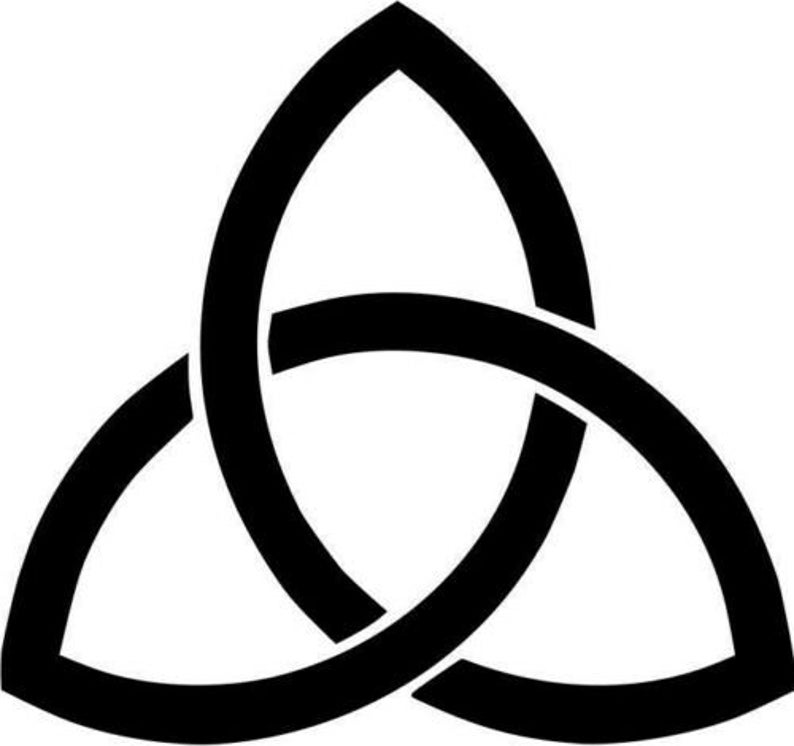
But symbols this persistent rarely survive by accident. The triquetra endures because it expresses a natural geometry that keeps re-emerging across systems—mathematical, physical, psychological, and metaphysical. Once you look at it closely, it becomes obvious that this is not ornamentation. It’s structure. A friend of mine wears one on his neck and it fits beautifully into my geometry of morality and consciousness.
The Geometry of Myth
For thousands of years, human beings have told stories about enlightenment, revelation, resurrection, apocalypse, and transformation. These stories differ in detail but not in structure. A prophet climbs a mountain and returns changed. A seeker descends into the underworld and rises renewed. A dying god collapses into darkness and re-emerges in light. A mystic enters a void and encounters a presence. At first glance, these look like metaphors, the shared vocabulary of cultures trying to articulate experiences beyond ordinary life.
But the more I’ve worked through the geometry of mind and meaning, the more convinced I’ve become that these myths share their forms because they map onto real structures in consciousness and reality. They are patterned the way they are because we are patterned the way we are.
Cyclohexane, Benzene & Graphene as Three Layers of Mind
If geometry helps explain moral orientation and theological tension, it also helps explain something closer to home: the shape of consciousness itself. Over time I’ve found that a surprisingly good analogy for the layers of mind comes from chemistry—specifically the way carbon arranges itself in three different structures: cyclohexane, benzene, and graphene. These molecules aren’t metaphors I’m forcing onto psychology; they carry real geometric insights about stability, resonance, and identity that map cleanly onto lived experience.
Just as with my moral geometry, I am searching for models that clarify and bring light. These three representations of carbon are a good model for how consciousness could be "layered" with emergent properties.
A Moment of Superposition or the Meaning of Choice
In the last two posts I outlined a moral geometry with two apexes: one that represents collapse into domination (the “black-hole” orientation) and one that represents expansion into generativity (the “white-hole” orientation). Most of our ethical and spiritual life unfolds somewhere between these two pull forces. But every once in a while, people describe an experience that sits at the boundary—a liminal state where the two orientations seem to overlap before diverging. I’ve come to call this threshold lavender resonance.
RSI vs Schwartz & MFT
People have been trying to map morality for a long time—sometimes explicitly, sometimes accidentally. Psychologists draw circles, philosophers draw ladders, and social scientists draw circumplexes of human motivation. But most of these systems collapse virtues, instincts, preferences, traditions, and even vices into the same diagram. The result is a kind of conceptual blurring.
So when I started building a moral geometry, I wanted a model grounded in relational, suffering, and intentional axes (R–S–I) and a six-virtue hexagon anchored in wisdom, courage, temperance, justice, compassion, and fidelity, I wanted to see how it stacks against the two most influential attempts at moral mapping today:
-
Schwartz’s Value Hexagon
-
Moral Foundations Theory (MFT)
Both offer sixfold structures. Both are widely used. Neither actually describes morality.
Here’s why—and how R–S–I fixes the problem.
On the R-S-I Model of Moral Space
I’ve been working toward a simple way to talk about morality without relying on commandments, theological rules, or even culture-specific lists of virtues. What I want is something structural—something that describes how people move through moral life the way physics describes objects moving through space.
The model that finally clicks for me uses three axes that seem unavoidable in every moral situation:
-
R — Relational: how we treat other people and how wide our circle of concern extends.
-
S — Suffering: how we respond to pain, loss, danger, and cost.
-
I — Intentional: what our will is actually aimed at—our real motivations beneath our self-stories.
These aren’t categories; they’re dimensions. Every moral act, good or bad, lives somewhere in this three-dimensional space.
The God of Black & White (holes)
If moral life has both a plane (the hexagon) and an axis (the dual apex), then theology has always been wrestling with the same geometry. You can see it across centuries of thought: two radically different visions of God, two radically different orientations toward ultimacy, housed uneasily within the same traditions.
One vision portrays the divine as a kind of gravitational center—absolute, commanding, hierarchical, demanding obedience. The other portrays the divine as an overflowing source—generative, self-giving, liberating, expansive. The tension is ancient, but once you view it through the lens of geometry, it becomes surprisingly clear that these aren’t two gods at all. They’re two apex orientations inside the manifold of Ground: I call this the "black hole" versus "white hole" model.
Monday, December 1, 2025
Toward a Moral Geometry
If geometry shapes the physical world, and if resonance shapes consciousness, then it shouldn’t be surprising that our ethical lives show patterns too. Moral experience doesn’t feel random. It has direction. It has shape. Choices feel like movements—not just decisions on a menu, but shifts in orientation: up or down, open or closed, toward or away. Long before I ever tried to formalize anything, I felt that moral life had a geometry.
The "Tuner" Mind
Some people understand the world through narrative. Others through logic. Others through image, or sensation, or purposeful action. Over the years I’ve noticed another style of mind—rarer, harder to describe, but instantly recognizable when you encounter it. I’ve come to think of it as the Tuner Mind: a cognitive architecture oriented less toward storytelling or argument and more toward resonance.
The Lavender Boundary
In the last post I sketched the basic geometric “alphabet” that seems to recur across physics, cognition, and meaning. But geometry alone isn’t enough. Something has to move in that geometry—vibrate, resonate, oscillate. And so we turn to frequency & spectra as a model/notation to use for what I’ve come to think of as the lavender boundary, a physical and phenomenological threshold where human perception breaks open into something stranger.
A critical definitional feature of the mystical experience is a sense of unity, or the experience of becoming one with all that exists. The boundary approaches this experience, and afterglow is its residue.
My Polygon Ontology
Over time I’ve found myself returning to four polygons that seem to function like an alphabet for both the physical world and the phenomenological one: the circle, the hexagon, the square, and the triangle. Each shape expresses a different way reality organizes itself. Together they form a cycle.
This isn’t a mathematical derivation. It’s a recognition that geometry has always been the language of both science and subjective experience. These four shapes show up everywhere—from molecules to myths, from symmetry groups to moral tension, from neural patterns to theological metaphors. I will use these shapes as an alphabet to build models with.
My PSG Manifold
As I’ve moved through physics, philosophy, teaching, and a lifetime of reflection, I’ve come to believe that all human knowledge—regardless of era or culture—falls into three basic modes of understanding. Not three subjects, but three axes of one manifold: Phenomena, Structure, and Ground. Every worldview emphasizes one of these, but a complete picture of reality needs all three.
The Case for a Unified Framework
Over the past few decades I’ve carried on three parallel conversations—one with science, one with philosophy, and one with the quiet, persistent experiences of my own mind. For years these stayed in separate compartments. Science belonged to the lab bench and the classroom. Philosophy lived in the books I read and wandering thoughts. And whatever I felt or glimpsed during moments of trauma, awe, grief, or deep focus—those belonged to no category at all.
Lately, those compartments have been collapsing. And what I hope to do is develop a new way of describing why those compartments are illusory. My descriptions rely upon my own experiences as a scientist, teacher, reader of philosophy, and seeker of truth.
Reclaiming the Oldest Idea in the World
I've been working on a project to unify disparate areas of physics, consciousness, philosophy & theology. This is a first post toward developing models that bring together human knowledge and experience.
Subscribe to:
Comments (Atom)