So a new study indicates (summary here) that if the current trend in the fastest-growing sector of American religion -- "none" or "not affiliated" -- continues, about 25% of Americans will belong to that group withing twenty years.
That's not surprising to me at all, and I actually think it may be a little low. The reason is that, as the authors report, a large chunk of the "none" crowd, or non-religious sector, as I think we ought to be referred, is young and 1st-generational. 30% of us are under 30 and only 5% over 70 (see Fig. 1.2). This means that our impact on our children will be felt in twenty years even as the current trend among our generation (Gen Y) continues.
See more atheism stats here.
I've said before (actually, quoted before) that the Religious Right is getting dumber with time. Want to see recent evidence? Check out a woman speaker suggesting that we have public abortions at the "Values Voters Summit" and this weeks' "How to Take Back America" conference co-chair elaborate on conspiracy theories. These people are complete nutjobs.
Showing posts with label statistics. Show all posts
Showing posts with label statistics. Show all posts
Sunday, September 27, 2009
Saturday, May 9, 2009

Tuesday, May 5, 2009
Pew Forum on changing religious landscape
This is similar to the ARIS data published a while back, and the statistics are in line with my list for the number of non-religious/unaffiliated and the percentage of those who are agnostic/atheist. Most interesting part of the report:
Compare this to those who used to be religious and now aren't:
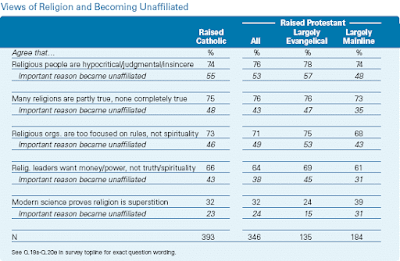 What I find completely unsurprising is that Evangelicals cite science as a motivating factor the least among other groups. You don't generally buy in to the whole Evangelical shebang if you are scientifically minded, so you won't be convinced by science that your religion is bullshit either.
Charles Blow finds this...encouraging? Or something? I love his quote:

Paradoxically, the unaffiliated have gained the most members in the process of religious change despite having one of the lowest retention rates of all religious groups. Indeed, most people who were raised unaffiliated now belong to a religious group. Nearly four-in-ten of those raised unaffiliated have become Protestant (including 22% who now belong to evangelical denominations), 6% have become Catholic and 9% are now associated with other faiths. Overall, 4% of the total U.S. adult population now belongs to a religious group after having been raised unaffiliated.So long as about 24% of us are non-theist, I will continue to sleep well at night:
Based on their stated beliefs rather than their religious identification in 2008, 70% of Americans believe in a personal God, roughly 12% of Americans are atheist (no God) or agnostic (unknowable or unsure), and another 12% are deistic (a higher power but no personal God).When you read the reasons for becoming religious after being raised non-religious, it's laughable for anyone religious to take comfort in these statistics: only half of new converts to religion from non-religion cite "spiritual needs" while the rest cite life contingencies -- a move to a new community, marrying someone from a faith, death and divorce. Isn't it wonderful how many people admit that tragedy is required to make them scared enough to believe in magic?
Compare this to those who used to be religious and now aren't:
 What I find completely unsurprising is that Evangelicals cite science as a motivating factor the least among other groups. You don't generally buy in to the whole Evangelical shebang if you are scientifically minded, so you won't be convinced by science that your religion is bullshit either.
Charles Blow finds this...encouraging? Or something? I love his quote:
While science, logic and reason are on the side of the nonreligious, the cold, hard facts are just so cold and hard. Yes, the evidence for evolution is irrefutable. Yes, there is a plethora of Biblical contradictions. Yes, there is mounting evidence from neuroscientists that suggests that God may be a product of the mind. Yes, yes, yes. But when is the choir going to sing? And when is the picnic? And is my child going to get a part in the holiday play?So this is how religious people justify it. On the one hand you have Carl Sagan's outlook:
For me, it is far better to grasp the Universe as it really is than to persist in delusion, however satisfying and reassuring.And on the other hand, you have people who would much rather persist in satisfying, reassuring delusion because the facts are cold and hard. Or is this just atheist hubris?


Sunday, April 12, 2009
"If I Only Had a Gun" ABCNews 20/20
First: I have two loaded shotguns within reach of my bed for home defense. Consider that before labeling me the new epithet: hoplophobe. I think it is wise to have a loaded shotgun in your home for this reason, but I obviously think it should be kept completely safe from children and teenagers. This was one of the main focal points of the program -- the statistics involving gun violence are staggering.
One of the major thrusts of the news piece was to inform viewers about the ridiculous gun show loophole that allows criminals and crazy people to buy guns, no questions asked, with no tracking records. It's fuc*ing insane. A young man whose sister was killed at VT went in and bought 15 guns in an hour, including handguns and shotguns and an assault rifle, no questions asked. No ID needed. And lawmakers have zero balls to do anything about it because they are beholden to gun nuts in this country.
All a sane citizen can hope for is a common sense common ground between allowing assault weapons to be sold to criminals and banning all guns outright. And that sort of middle ground does exist. In England, handguns are illegal and their murder rate is one-third of ours. Handguns are used in 8 of 10 murders by firearms. That still gives law-abiding citizens the right to bear arms, just not a certain kind of them. Obviously, that's already the case! We already can't legally own Stinger missiles either, but is that an infringement of our 2nd Amendment rights? No. Ditto for many other kinds of "arms" that are illegal.
I watched the 20/20 piece and came away semi-informed as to the general difficulty of responding with force when a shooter is causing carnage all around you. Basically, your adrenaline counteracts your ability to think clearly and aim effectively, and likely your gun is stowed in an inconvenient place so that you will have to be exposed to pull it out and use it. I don't want to carry concealed, mainly due to the fact that I don't think we need to return to the Wild West where everyone is out there with a gun fending for themselves. The probability of needing to have a gun to defend yourself is basically very unlikely compared to the risk involved in carrying one.
I have often argued with gun nuts that while there were 134 "justifiable homicides" with a handgun in 1999, there were 866 (6.5 times that many) accidental fatal shootings, 314 deaths where intent was unclear, 12,102 murders and 17,424 suicides in 1998. There were 336 deaths of children by accidental shootings in 1998. This basically shows you that the idea that you'll likely need to defend yourself with lethal force is a poor excuse for carrying a gun. It is 3 times likelier a child will be killed by your gun, 6.5 times likelier that someone will be accidentally killed with your gun, 120 times likelier someone will be murdered with it and 170 times likelier someone will use it to commit suicide. And, the 134 justifiables include police shootings! Probably less than a third of that number comes from citizens defending themselves and/or their homes. I will do some research this summer, rather than a few quick Google searches, and compile more relevant statistics and correlations.
Critics of the 20/20 program say the show was unrealistic, but I think they are distorting the facts. They claim the instructor immediately went for the kid with the gun, but as you can see from the clip, that is blatantly untrue. The instructor killed the lecturer first, then went right-to-left sweeping through the room, shooting everyone along the way. The students with the gun were often hit early because they stood erect, trying to unholster the weapon, rather than taking cover first. The other people in the room ran wildly in all directions, ducking.
One of the major thrusts of the news piece was to inform viewers about the ridiculous gun show loophole that allows criminals and crazy people to buy guns, no questions asked, with no tracking records. It's fuc*ing insane. A young man whose sister was killed at VT went in and bought 15 guns in an hour, including handguns and shotguns and an assault rifle, no questions asked. No ID needed. And lawmakers have zero balls to do anything about it because they are beholden to gun nuts in this country.
All a sane citizen can hope for is a common sense common ground between allowing assault weapons to be sold to criminals and banning all guns outright. And that sort of middle ground does exist. In England, handguns are illegal and their murder rate is one-third of ours. Handguns are used in 8 of 10 murders by firearms. That still gives law-abiding citizens the right to bear arms, just not a certain kind of them. Obviously, that's already the case! We already can't legally own Stinger missiles either, but is that an infringement of our 2nd Amendment rights? No. Ditto for many other kinds of "arms" that are illegal.
I watched the 20/20 piece and came away semi-informed as to the general difficulty of responding with force when a shooter is causing carnage all around you. Basically, your adrenaline counteracts your ability to think clearly and aim effectively, and likely your gun is stowed in an inconvenient place so that you will have to be exposed to pull it out and use it. I don't want to carry concealed, mainly due to the fact that I don't think we need to return to the Wild West where everyone is out there with a gun fending for themselves. The probability of needing to have a gun to defend yourself is basically very unlikely compared to the risk involved in carrying one.
I have often argued with gun nuts that while there were 134 "justifiable homicides" with a handgun in 1999, there were 866 (6.5 times that many) accidental fatal shootings, 314 deaths where intent was unclear, 12,102 murders and 17,424 suicides in 1998. There were 336 deaths of children by accidental shootings in 1998. This basically shows you that the idea that you'll likely need to defend yourself with lethal force is a poor excuse for carrying a gun. It is 3 times likelier a child will be killed by your gun, 6.5 times likelier that someone will be accidentally killed with your gun, 120 times likelier someone will be murdered with it and 170 times likelier someone will use it to commit suicide. And, the 134 justifiables include police shootings! Probably less than a third of that number comes from citizens defending themselves and/or their homes. I will do some research this summer, rather than a few quick Google searches, and compile more relevant statistics and correlations.
Critics of the 20/20 program say the show was unrealistic, but I think they are distorting the facts. They claim the instructor immediately went for the kid with the gun, but as you can see from the clip, that is blatantly untrue. The instructor killed the lecturer first, then went right-to-left sweeping through the room, shooting everyone along the way. The students with the gun were often hit early because they stood erect, trying to unholster the weapon, rather than taking cover first. The other people in the room ran wildly in all directions, ducking.
Sunday, March 15, 2009
Comment on changes in American religious landscape
From Andrew Sullivan writing in the UK TimesOnline:
American Christianity may be stronger in some pockets, but it is dumber too. In the end, in the free market-place of ideas and beliefs, that will count.It already has.
Statistical feelings about Bible
The new GSS data (H/T: 538) for 2008 is released on a preliminary basis, and since I organized some "no religion" statistics a little while back I thought I'd throw this one in: about 1 in 5 of us don't take the Bible seriously as God's book.
 16.2% outright call it a book of "fables, legends, history, and moral precepts written by men" while 1.2% say "other" and 1.6% "don't know". It's a good sign, and let's keep hoping that number increases with time.
 16.2% outright call it a book of "fables, legends, history, and moral precepts written by men" while 1.2% say "other" and 1.6% "don't know". It's a good sign, and let's keep hoping that number increases with time.
Monday, March 9, 2009
Atheism statistics
This post will serve solely as a reference. For more analysis/opinion see all posts tagged "social analysis".
- Feb 2009 CUNY ARIS, 12.3% atheist + agnostic
- Apr 2008 Harris, 28% "not religious", 14% "not at all religious" [table 6]
- Nov. 2007 Harris, 18% atheists + agnostics (82% believe in God)
- Nov 2007 various by Zuckerman and Paul, "America's disbelievers...number 30 million, ...far outnumber American Jews, Muslims and Mormons combined."
- Aug 2007 Pew, nonreligious: 16.1%, with 4% atheist + agnostic and 12.1% generally unaffiliated
- Mar 2007 Newsweek, 10% "no religion", 6% atheist + agnostic
- 1972-2006 GSS Data, 14.4% "not religious" [here], 6.1% atheist [here]
- Dec 2006 Harris, 14% agnostic, 4% atheist, 6% "would prefer not to say"
- Sept 2006 Baylor U., 10.8% "religious nones," 5.2% atheists
- 2005 Adherents.com global data, 16% of people globally are atheist, agnostic, or related
- May 2004 Pew, 16% "unaffiliated", 7.5% "secular" and 3.2% "atheist, agnostic"
- Dec 2001 CUNY ARIS, "no religion" 8% in 1990, 14% in 2001. 14.3 million in 1990, 29.4 million in 2001 (more here)
Wednesday, September 13, 2006
New God Study
A new Baylor study on religious beliefs is a bit more detailed than most. You can download the full report, American Piety in the 21st Century: New Insights to the Depths and Complexity of Religion in the U.S.
Many prior studies, like the CUNY ARIS I've discussed, had very generic categories of belief, and very simple questions regarding faith in God. These sorts of studies consistently found the amount of nonreligious persons in the mid-teens. This study aimed to differentiate faith in types of God, and its results are very interesting. For one thing, although 10.8% of persons are "religious nones", only 5.2% were willing to self-identify as atheists. The researchers think that the lower score here is due to the more pointed questions which differentiate between unaffiliated religious persons (unaffiliated with a particular church or denomination) and truly nonreligious persons.
USA Today
Chron.com
________________
Technorati tags: Religion
In 2004, the General Social Survey reported that 14.3 percent of the population had no religion, but by using a more detailed measure in the Baylor survey, researchers determined that only 10.8 percent of the population or approximately 10 million Americans are unaffiliated.The four "God types", referred to as Type A, B, C and D, and their % belief:
"We believe, and are going to argue, that it [the statistics] has more to do with how you ask about the religious connection than what it says about the commitment of the average American to their faith," said Dr. Kevin Dougherty, assistant professor of sociology and one of the Baylor Survey researchers. (Baylor U source article)
Authoritarian: 31.4%Another breakdown (interesting!) by regional majority of each type view:
Benevolent: 25.0%
Critical: 16.0%
Distant: 23.0%
NE -- 21.2% CriticalOf course, the high amount of Jewish persons and liberal Christians (both Catholic and Protestant) in the NE made me predict that Distant would win there, not Critical.
South -- 43.5% Authoritarian
West -- 30.3% Distant
Midwest -- 28.8% Benevolent
USA Today
The four visions of God outlined in the Baylor research aren't mutually exclusive. And they don't include 5.2% of Americans who say they are atheists. (Although 91.8% said they believe in God, some didn't answer or weren't sure.)The Waco Tribune-Herald
For example, there is a strong gender differential in belief in God. Women, he said, tend toward the more engaged versions (types A and B), while men tend toward the less engaged and are more likely to be atheist.Something else I'm not surprised about?
More than half the blacks in the study said they believe in the Authoritarian God. None surveyed said they were atheist.
Lower-income and less-educated folk were more likely to worship god types A or B, while those with college degrees or earning more than $100,000 were more likely to believe in the Distant God or be atheists, the Baylor study concluded.
Getting agnostic and even atheist participation on Baylor’s religion survey didn’t seem to be a problem, he added. Although 10.8 percent did not claim any affiliation with any faith family or house of worship, only 5.2 percent of those surveyed declared themselves to be atheists.
Chron.com
It found that about 41 percent believe Atlantis existed; 37 percent believe places can be haunted; and 52 percent believe that dreams can foretell the future. About 12 percent believe in astrology and psychics, and about 25 percent believe in UFOs.There is, and always has been, a sort of pervasive superstitous human mindset. When people accept magical, invisible beings, (angels, demons, gods) and miracles with little or no evidence, their credulity simply extends to other regions of naïveté as well -- Atlantis being a real place, UFOlogy, Bigfoot, Loch Ness...etc. Religious belief either causes this lower bar of skeptical thinking or is a symptom thereof, but it clearly correlates with it.
________________
Technorati tags: Religion
Monday, August 28, 2006
There IS Hope
Two recent articles from the National Secular Society filled me with hope for our future this morning: Australian Youth Follow The Secular Trend, and Spanish Youngsters Have Had It With Religion, Too. From the articles (also see here):
Australian Youth Follow The Secular Trend
Aug. 11, 2006
Less than half Australia’s young people say they believe in a god, and many believe there is little truth in religion, a new study has found. The three-year national study, a joint project between Monash University, the Australian Catholic University and the Christian Research Association, found many young people live an entirely secular life.
The study, The Spirit of Generation Y, found just 48 percent of those born between 1976 and 1990 believed in a god. Dr Andrew Singleton of Monash University, a co-author of the study, said they were surprised by the findings. "It’s well known that there has been a turn away from church attendance and participation in young people," he said. "But we thought there was going to be a move towards alternative spiritualities. There are still a number turning towards it, but not as big as you would have thought."
Religious identity will be among the questions contained in this year’s Australian census. We see the same effect in this census as in the UK census, when 72% of people said they were Christian, even though every other survey and poll showed this to be vastly over-stated. This was because of poor wording of the question.
The Australian survey found 20 percent of young people did not believe in a god and 32 percent were unsure. It also found just 19 percent of those who identify themselves as Christian was actively involved in a church (attending services at least once a month). More than 30 percent of Generation Y was classified as "humanists," rejecting the idea of a god, although some believed in a "higher being."
Dr Singleton said it was a trend that was likely to continue. "We live in a very individualistic and self-orientated society and I don't see a lot of things challenging that," he said. “One of the many predictors of whether we become religious is our parents, and unless there is a massive cultural shift, I see that the trajectory will continue as it is."
Spanish Youngsters Have Had It With Religion, Too
Aug. 11, 2006
A poll of 1,450 young people in Spain shows that most believe that religion is of little importance and has no place in schools. The survey of people aged 15 to 29 shows that attitudes have changed radically since the era of the dictator Franco. Then, homosexuality was banned. Now gay marriage is legal, with 80 percent of those who were asked agreeing with the change in the law.
More than two thirds of those polled said they were in favor of abortion (legalized in Spain in 1985) and 76 percent said they approved of euthanasia "to help someone suffering from an incurable disease if they asked for it." A third declared themselves non-believers, with the majority of the remainder stating that religion had little relevance in their lives.
Although this will be good news for the socialist government of José Luis Rodriguez Zapatero, it will cause yet more angst among the Catholic hierarchy who have traditionally held enormous power in Spain.
________________
Technorati tags: Secularism
Aug. 11, 2006
Less than half Australia’s young people say they believe in a god, and many believe there is little truth in religion, a new study has found. The three-year national study, a joint project between Monash University, the Australian Catholic University and the Christian Research Association, found many young people live an entirely secular life.
The study, The Spirit of Generation Y, found just 48 percent of those born between 1976 and 1990 believed in a god. Dr Andrew Singleton of Monash University, a co-author of the study, said they were surprised by the findings. "It’s well known that there has been a turn away from church attendance and participation in young people," he said. "But we thought there was going to be a move towards alternative spiritualities. There are still a number turning towards it, but not as big as you would have thought."
Religious identity will be among the questions contained in this year’s Australian census. We see the same effect in this census as in the UK census, when 72% of people said they were Christian, even though every other survey and poll showed this to be vastly over-stated. This was because of poor wording of the question.
The Australian survey found 20 percent of young people did not believe in a god and 32 percent were unsure. It also found just 19 percent of those who identify themselves as Christian was actively involved in a church (attending services at least once a month). More than 30 percent of Generation Y was classified as "humanists," rejecting the idea of a god, although some believed in a "higher being."
Dr Singleton said it was a trend that was likely to continue. "We live in a very individualistic and self-orientated society and I don't see a lot of things challenging that," he said. “One of the many predictors of whether we become religious is our parents, and unless there is a massive cultural shift, I see that the trajectory will continue as it is."
Spanish Youngsters Have Had It With Religion, Too
Aug. 11, 2006
A poll of 1,450 young people in Spain shows that most believe that religion is of little importance and has no place in schools. The survey of people aged 15 to 29 shows that attitudes have changed radically since the era of the dictator Franco. Then, homosexuality was banned. Now gay marriage is legal, with 80 percent of those who were asked agreeing with the change in the law.
More than two thirds of those polled said they were in favor of abortion (legalized in Spain in 1985) and 76 percent said they approved of euthanasia "to help someone suffering from an incurable disease if they asked for it." A third declared themselves non-believers, with the majority of the remainder stating that religion had little relevance in their lives.
Although this will be good news for the socialist government of José Luis Rodriguez Zapatero, it will cause yet more angst among the Catholic hierarchy who have traditionally held enormous power in Spain.
________________
Technorati tags: Secularism
Subscribe to:
Posts (Atom)