Every once in a while you encounter a symbol that feels older than any single religion or culture. The triquetra—also called the tiny trinity or trinity knot—is one of those shapes. It shows up everywhere: Celtic manuscripts, Norse carvings, Buddhist temple knots, Hindu yantras, medieval Christian iconography, Slavic designs. It appears in places that could not have influenced each other, separated by centuries or continents. Most people chalk this up to coincidence, or aesthetic preference, or diffusion.
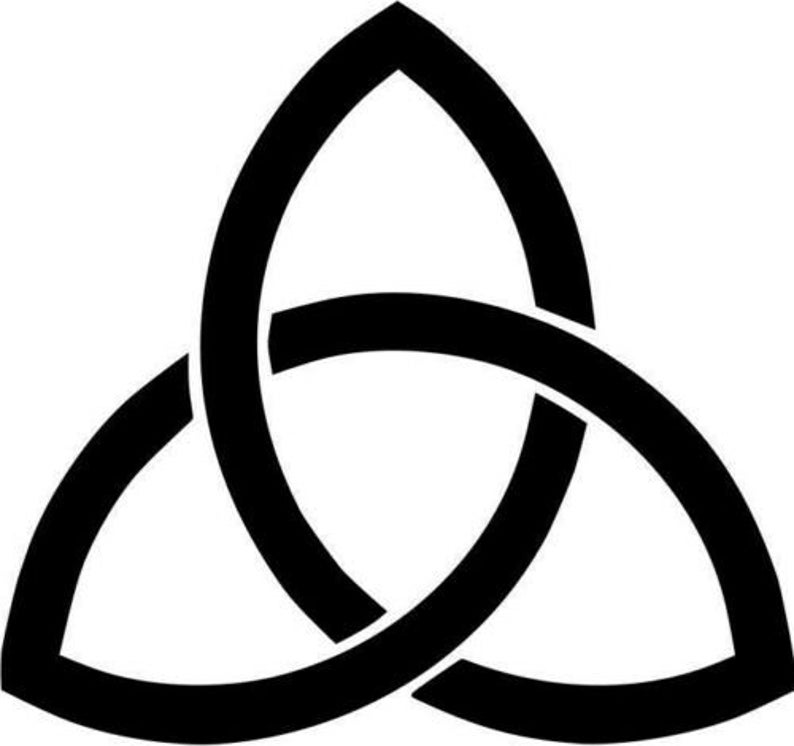
But symbols this persistent rarely survive by accident. The triquetra endures because it expresses a natural geometry that keeps re-emerging across systems—mathematical, physical, psychological, and metaphysical. Once you look at it closely, it becomes obvious that this is not ornamentation. It’s structure. A friend of mine wears one on his neck and it fits beautifully into my geometry of morality and consciousness.
Mathematically speaking, the triquetra is not three ovals woven together; it is a projection of a trefoil knot, the simplest nontrivial knot in existence. The trefoil has genus 1, crossing number 3, and braid index 2. In knot theory it functions like what the hydrogen atom is in quantum mechanics—the minimal case where complexity first appears. When you compress the trefoil into a plane, you get the familiar three-lobed trinity knot, complete with implicit over-under braiding.
That explains part of its appeal: the triquetra has built-in dynamism. It is literally a 3D braided curve folded into 2D. Nothing about it is static. Even its symmetry group—C₃, the threefold rotational symmetry—makes it feel alive. Rotate it 120 degrees and it maps onto itself. Rotate it again and it still matches. But reflect it, and something breaks: the over-under braiding reverses. Mathematically, the shape is chiral—it has a handedness. And that fact alone makes it feel directional.
This is where the triquetra connects to philosophy. A symbol with inherent directionality speaks to systems with orientation: ascent vs. descent, generativity vs. collapse, outward motion vs. inward implosion. In earlier posts I described the dual-apex moral geometry as a kind of white-hole/black-hole axis. The triquetra sits naturally at the intersection of those flows: three equal vectors cycling around a central singularity. It is the geometry of triadic movement—of systems that never sit still.
The triquetra also maps neatly onto the P–S–G manifold: Phenomena, Structure, and Ground. Each lobe can represent one of the three modes of human knowledge. But the shape only makes sense when all three are joined by the same continuous curve. You can’t delete one lobe without breaking the entire knot. Phenomenology without Structure collapses into relativism. Structure without Ground becomes sterile or authoritarian. Ground without Phenomena turns mystical insight into abstraction. The triquetra is a picture of what it means for the three to interpenetrate: distinct, but inseparable.
There’s another layer: the triquetra is what dynamical systems naturally produce when three attractors are arranged in balanced competition. Certain replicator systems, when tuned symmetrically, generate three-lobed limit cycles that look exactly like the triquetra when projected. Predator–prey–superpredator models, three-mode neural oscillators, triadic political cycles, even three-way ideological tensions—these all create flows that trace out triquetra-like patterns in phase space. When a system has three forces of equal weight pulling on one another, the geometry wants to braid.
This is why cultures rediscovered the shape independently. The triquetra is what triads look like when they move.
What makes the shape so compelling is that it encodes several philosophical properties at once:
-
Nonlinearity — it’s not three circles; it’s a braided orbit.
-
Continuity — one unbroken path links all three modes.
-
Balance — no lobe dominates or diminishes the others.
-
Recurrence — the curve cycles endlessly back into itself.
-
Orientation — clockwise vs. counterclockwise flow changes interpretation.
The triquetra is minimal complexity in knot form, but maximal interpretive richness. It is the smallest shape capable of expressing intertwined unity without reducing difference. It's a 3D version of the leminscale's
In future posts, I may take this one step further—mapping flows through the triquetra and showing how different orientations correspond to different transformations of consciousness, ethics, and meaning. But even as it stands, the tiny trinity is a reminder that some symbols survive because they express something fundamental. They’re not just art. They’re geometry.

